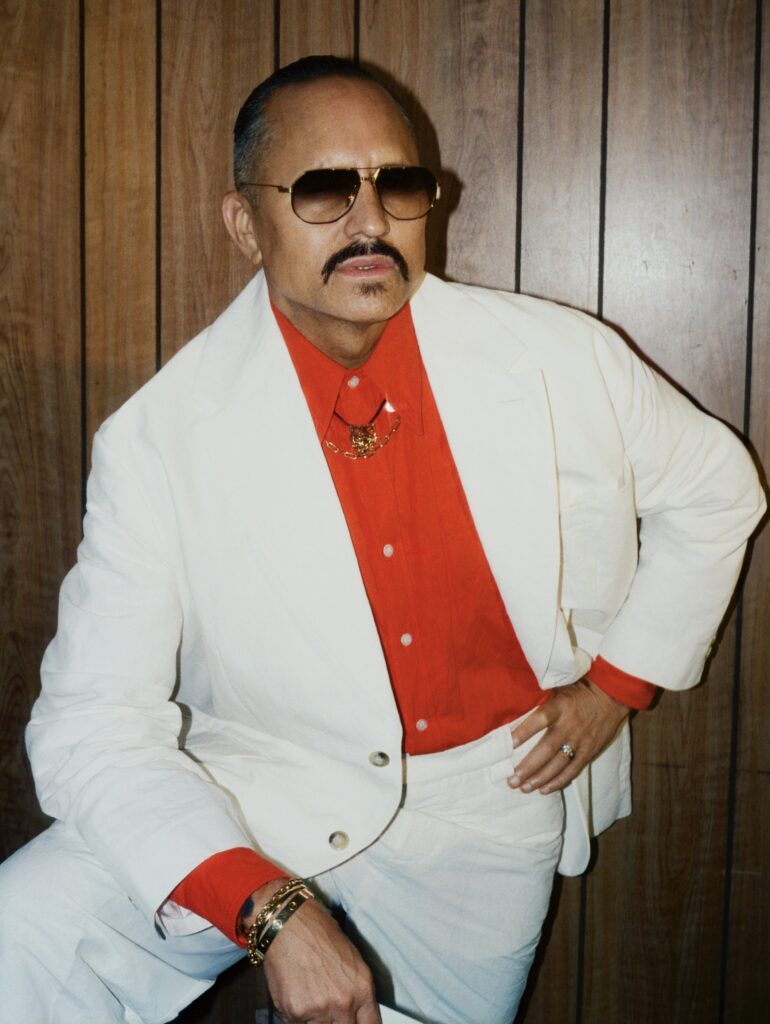

The late Giorgio Armani, who appeared on the cover of PLAYERS’ debut issue, built a universe of elegance that extended far beyond fashion and into film, hospitality, architecture and even basketball through his ownership of Olimpia Milano. His was a kind of total world-building that is rare among designers today, especially those still early in their ascent.
Yet it’s a quality that defines Willy Chavarria, the New York–based designer whose expanding universe is rooted not in luxury’s distance but in human connection. Like Armani, Chavarria sees clothing as a system of belief, one that can shape how people move through the world and how the world moves around them.
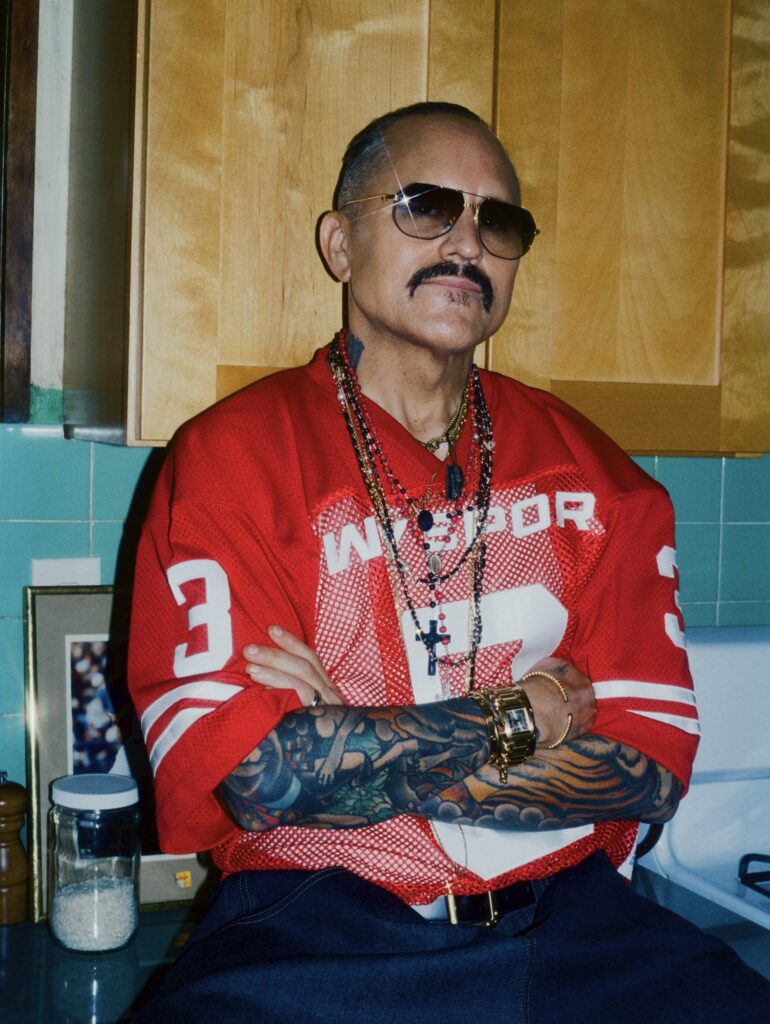
While vastly different, the parallels are striking. Both men are anchored in tailoring: Armani’s fluid, deconstructed suits became the unofficial uniform of the 1980s corporate elite, dressing the boardroom as much as Hollywood and softening masculinity without ever questioning who held power.
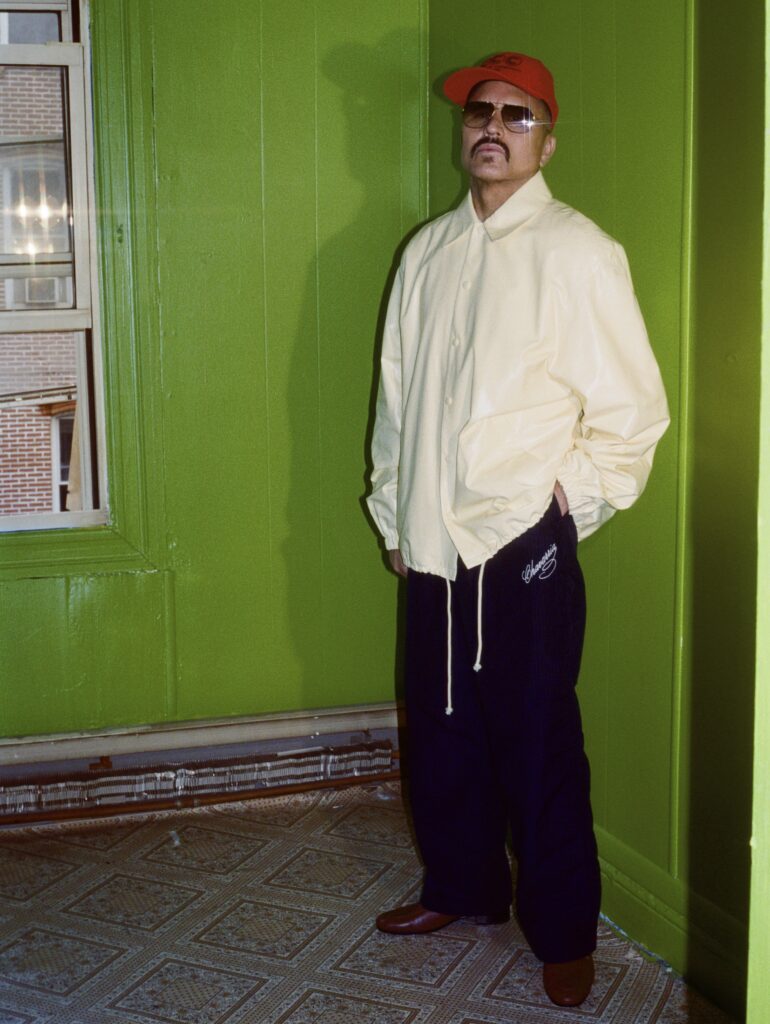
Chavarria’s tailoring, by contrast, applies that same language of structure and presence to a different cast of characters. Let’s call them the underdogs: queer bodies, athletes, migrants, street kids. His oversized jackets and floor-sweeping trousers are often paired with track pants or sportswear, suggesting a masculinity less about domination and more about visibility and individuality — a modern archetype built from the margins rather than the center.
Both see fashion as a vehicle for something larger. For Armani, it was cinema, architecture and sport. For Chavarria, too, sport is a recurring theme, but then so is something bigger: politics. A refusal to separate clothing from the complex realities of identity, race and community. If Armani taught us how to dress for a world of elegance, Chavarria is teaching us how to dress for a world in upheaval.
Though it’s the symbolism of sport that grabs Chavarria’s attention. “Honestly, I rarely watch football games,” Chavarria admitted, with a laugh, recalling Super Bowl tickets he once had and never used. “But the ideology of sports has always intrigued me. … It’s the one arena that is all-inclusive. You can put a soccer ball in a field anywhere in the world and eventually there will be a game. That kind of universality really inspires me.”
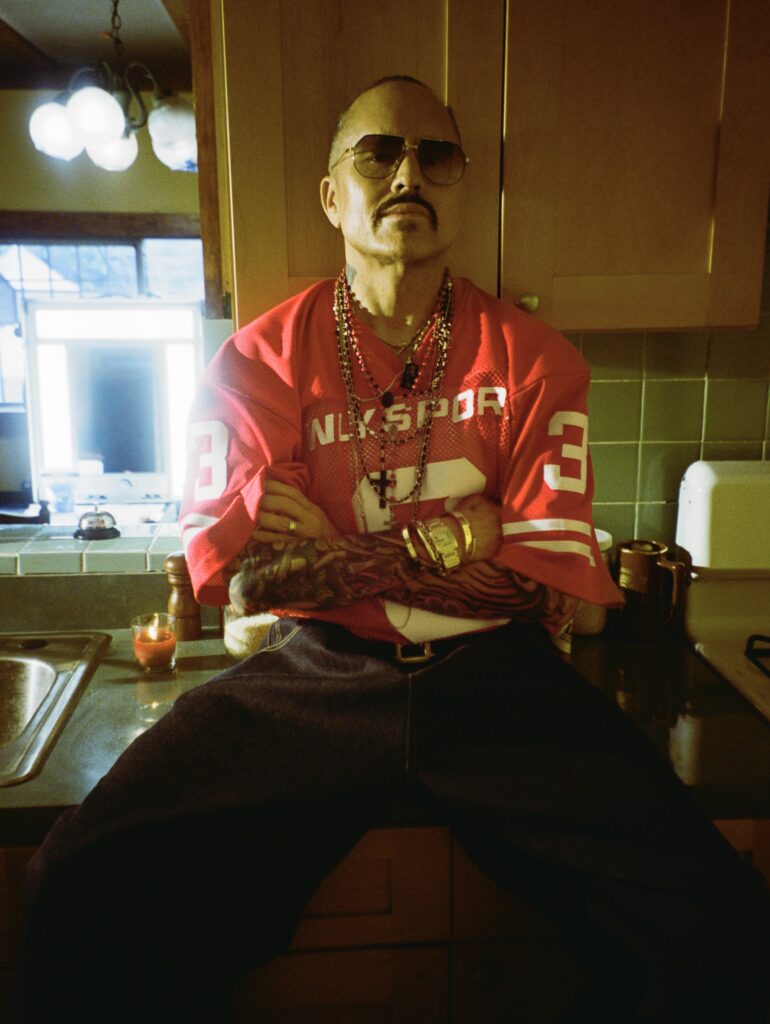
It is, then, no surprise athletes gravitate to his clothes, garments that carry the same insistence on freedom. “They don’t want to feel confined,” he said of players who shop his collections and those, including NFL star Stefon Diggs and NBA player James Harden, who have walked his runway shows. “That’s something I’ve built into my design philosophy, to hook those guys up.”
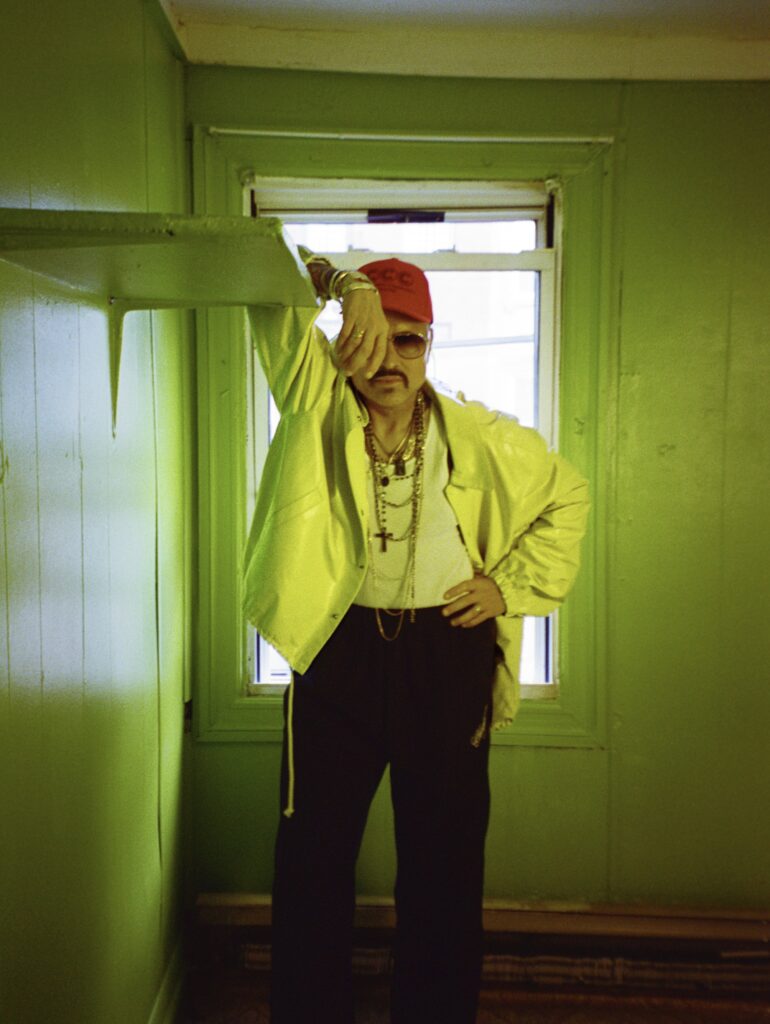
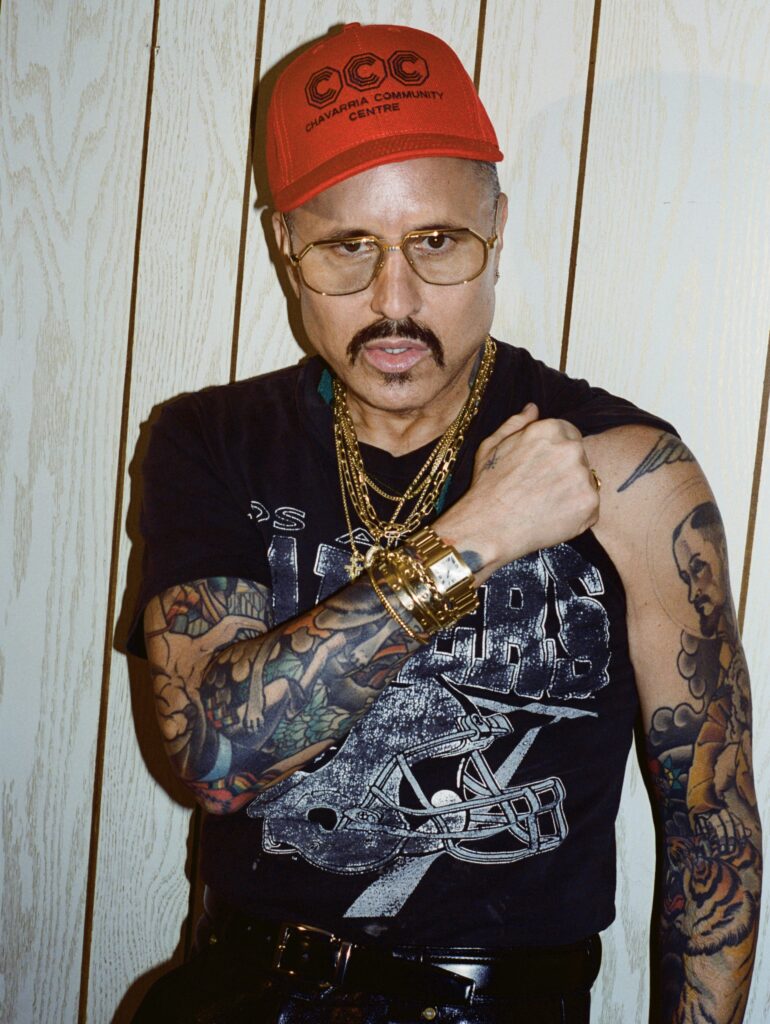
FROM FRESNO TO THE WORLD
Chavarria’s politics are not abstract. Born in a small city near Fresno, California, into a Mexican-American family, he grew up with an acute awareness of social inequality. As a boy, he sketched clothes, but it was graphic design that first captured his imagination. He studied commercial art at the Academy of Art University, believing his future lay in advertising. Fashion arrived almost by accident, through a shipping job at Joe Boxer in San Francisco.
“I started packing boxes, then got pulled into the design team,” he recalled. “Seeing an idea go from sketch to textile to the body of a stranger was intoxicating.” He designed underwear and pajamas, cutting and pasting layouts in the pre-digital era, shipping swatches to mills and approving strike-offs. It was a craft that fused process and intimacy — the thrill of knowing someone would reach for his garment in the morning and put it against their skin.
From Joe Boxer came Ralph Lauren, where he worked on the then-newly launched RLX sportswear line. The experience was glamorous on the surface, but it panned out differently. “It was my first fashion job, and I absolutely hated it,” he admitted. Yet the time was formative. At Calvin Klein, he would later hone a sharper, more political eye, experimenting with casting that challenged conventions and celebrated diversity long before it became industry shorthand.
A stint at YEEZY followed, where Chavarria witnessed how a brand could move like a cultural earthquake, collapsing the boundaries between athletics, streetwear and luxury, and, more importantly, speaking directly to real people outside of fashion’s often insular ecosystem. It was a lesson in scale, in resonance and in the possibility of building something that felt both human and true.
Chavarria has always had a fascination with sportswear and identity. “In my small town, a full-on fashion look would be a Cowboys jersey with a Cowboys cap, a white T-shirt and khakis. That was a look. I had all the Raiders stuff, and I never watched a Raiders game. The bridge between athletics and fashion was always there.”
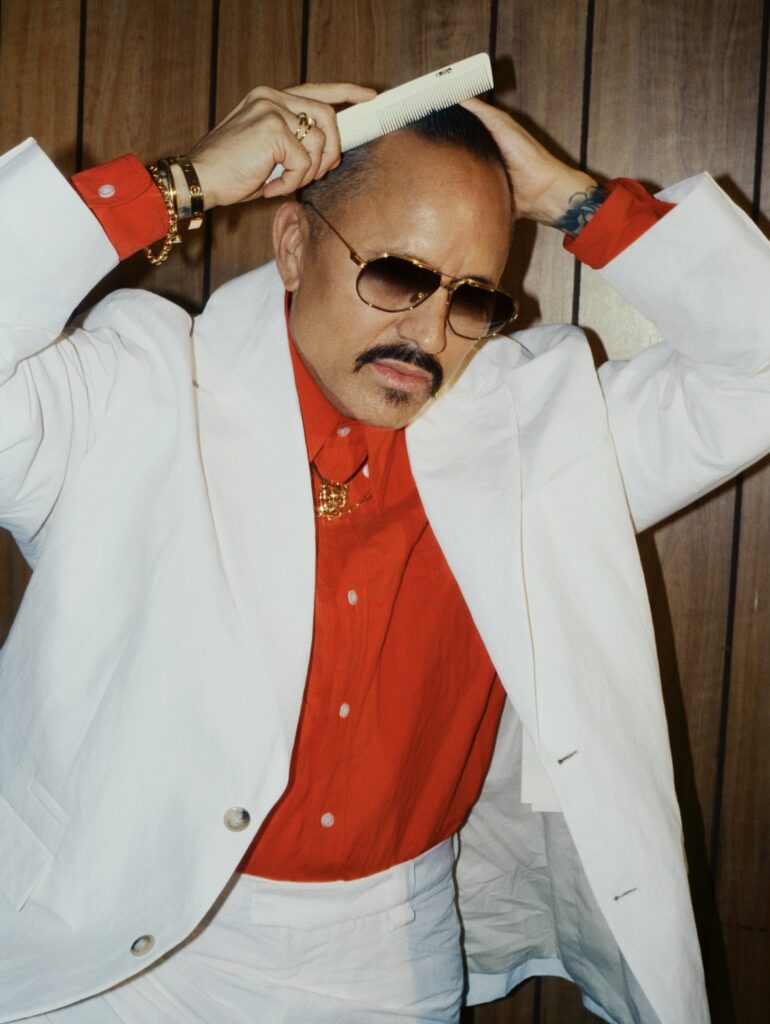
Years later, that same bridge would bring musicians and athletes to his own clothes. Kanye West, for instance, famously lived in a pair of Chavarria’s Hummel collaboration pants for two years, proof that Willy’s fusion of tailoring and sportswear could travel from Fresno’s streets to global icons.
FASHION AS POLITICAL STAGE
But today, celebrities wearing your clothes is simply the norm rather than the exception. To break through in such a crowded landscape, something bigger, more visceral, is required. For Chavarria, that “something” has always been politics. “I’ve always believed fashion is a platform,” he said. “People look at fashion more than they look at the news. If I can make them feel seen (people who are ignored, people who are dismissed), then I’ve done my job.”
This belief animates every Chavarria show. Casting is deliberate, even confrontational: the so-called “oddballs” he proudly centers. His runways feel like cinematic essays on identity and power, paying little attention to fleeting trends.
“Some of us don’t have the luxury of ignoring these things,” he said. “For me and my team, what’s happening now in the country is top of mind every day, and that’s reflected in how we design, how we connect with people and how we want to make them feel.”
That philosophy reached a global audience in June at Paris Fashion Week Men’s, when Chavarria opened with a haunting tableau evoking the reality of ICE detention. His cast (a mix of long-time collaborators and new faces drawn from an open call) appeared in stark uniforms of oversized white tees and loose shorts.
One by one, they knelt with hands clasped behind their backs, their shaved heads a chilling reference to the imagery of incarceration. The scene was unsettling and unforgettable: fashion recast as testimony, forcing the audience to confront the human cost of America’s new, tough immigration policy. It was the kind of moment that confirmed Chavarria’s status as a designer unwilling to separate beauty from brutality, or clothing from the politics of survival.
RECOGNITION AND RESPONSIBILITY
This kind of insistence that fashion carries weight has earned him accolades as well as attention. Chavarria was a finalist for the International Woolmark Prize in 2018, a winner of the CFDA Vogue Fashion Fund in 2021, and a recipient of the Cooper Hewitt Smithsonian National Design Award for Fashion Design in 2022. In 2023, he was named CFDA Menswear Designer of the Year (followed in 2024 by the same honor); just days before, the Latin American Fashion Awards recognized him as Designer of the Year.
But he treats recognition less as arrival than as responsibility. The awards simply affirm what he already knows: that politics and aesthetics are not opposing forces but intertwined imperatives. For a new generation of discerning customers, clothes are no longer just garments but statements, a way to align with brands that stand for something deeper than style alone.
A BUSINESS RESET
Conviction, however, does not build a company on its own. “About three years ago, I realized I wanted this to be really big. To do that, I had to get serious about the business side. My husband came on as COO, and that was critical. Being American, you almost have to be half businessman, half designer. The economy here is really like a Wall Street economy, [whereas] in, let’s say, a Paris, it’s a fashion economy,” he said, with a laugh.
The pragmatism has sharpened his ethos. Today, much of his production takes place in Italy, where quality has soared while price points remain consistent. Denim and knits are made back home in California. He has introduced long-term collaborations with Adidas and Dickies, as well as a much-loved partnership with Danish sportswear brand Hummel. A new democratic line is in the works, designed to broaden reach without diluting the message. “Not everyone can afford a $500 piece,” he said. “I never wanted this brand to be exclusionary.”
The paradox is clear: Capitalism is the system he operates within as well as the one he critiques. Chavarria does not deny it. Instead, he leans into the tension. “At one point, I had a label on every garment that said, Capitalism is heartless. And those clothes were sold at Barneys. That sums it up: We live in a capitalist world, but it’s up to us to take care of one another.”
As he explained, “We’re really run by this philosophy of how we have to work and how we function. But at the end of the day, it’s up to us to take care of one another and make sure that we are good to one another. And I’ve truly built my business with that notion in mind.”
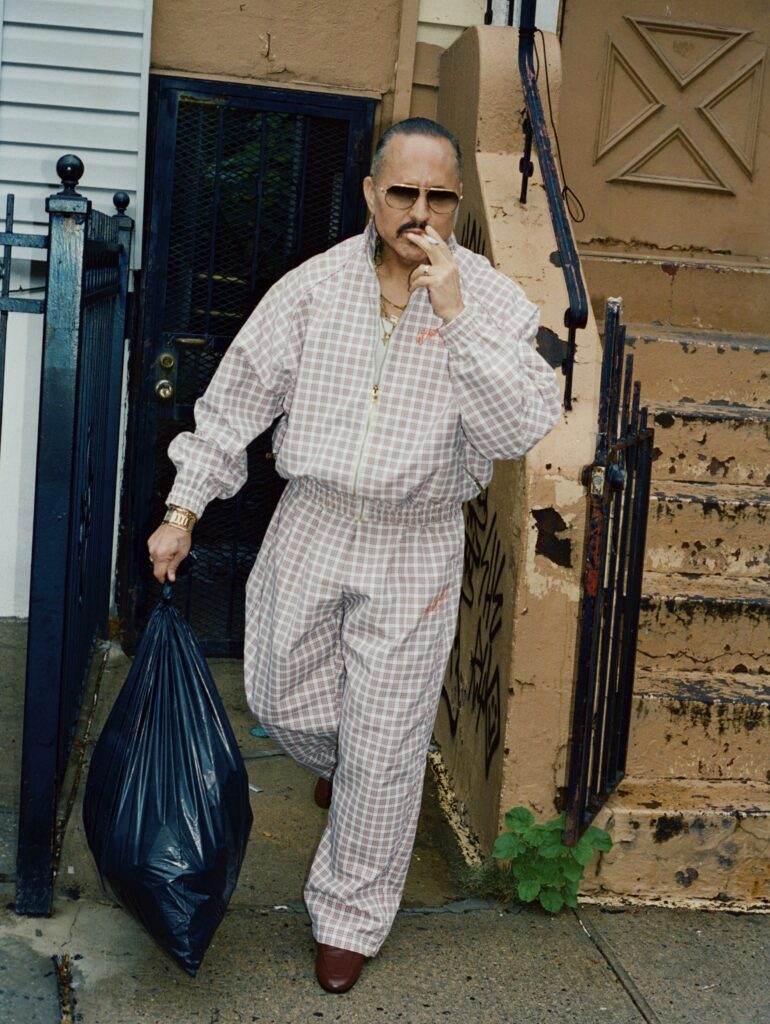
That ethos extends to his team itself. “The people that I work with and the people that have been drawn into the business all really hold that same philosophy. And the ones who don’t… they just don’t last. The core message of the brand is really human dignity and giving everyone the benefit of the doubt. Making us all feel as excellent and capable as we are. And I think that is a message that can expand to touch as many people as possible.”
And people are responding to that message, with the business growing fast. According to Chavarria, for three years running, he has exceeded his own growth targets. Expansion in Asia and Europe is underway, with stand-alone boutiques and immersive environments in development. He imagines spaces where fashion merges with art, music and theater. “If that is the message,” he said, “then everything you’re doing behind it is just to project that message. So, there’s the selling of clothes, there’s the making of music, there’s the selling of art — whatever your path is to live in this capitalist environment, it’s the motive behind it that really matters.”
But he always links back to that realness. “I want the brand to be something that makes everyone feel seen, and activates something within people to feel better about themselves.”
He also knows that in an unstable political moment, that vision cannot be carried alone. “The USA, which was a democracy, is quickly transforming into an autocracy,” he said. “I don’t see any other way for it to stop without a revolt by the people. And in times like this, it’s very important, even as it ties back to sports, to exist within a team. To exist within people that are aware of what’s going on and working with you to deal with it, whether on an emotional, activist or intellectual level. We need our force around us.”
That, ultimately, is the torch he carries. If Armani built an empire from elegance, then Chavarria is building an empire of dignity, one that insists on truth, solidarity and the strength of the collective. And in today’s fashion, that is the more urgent lesson.