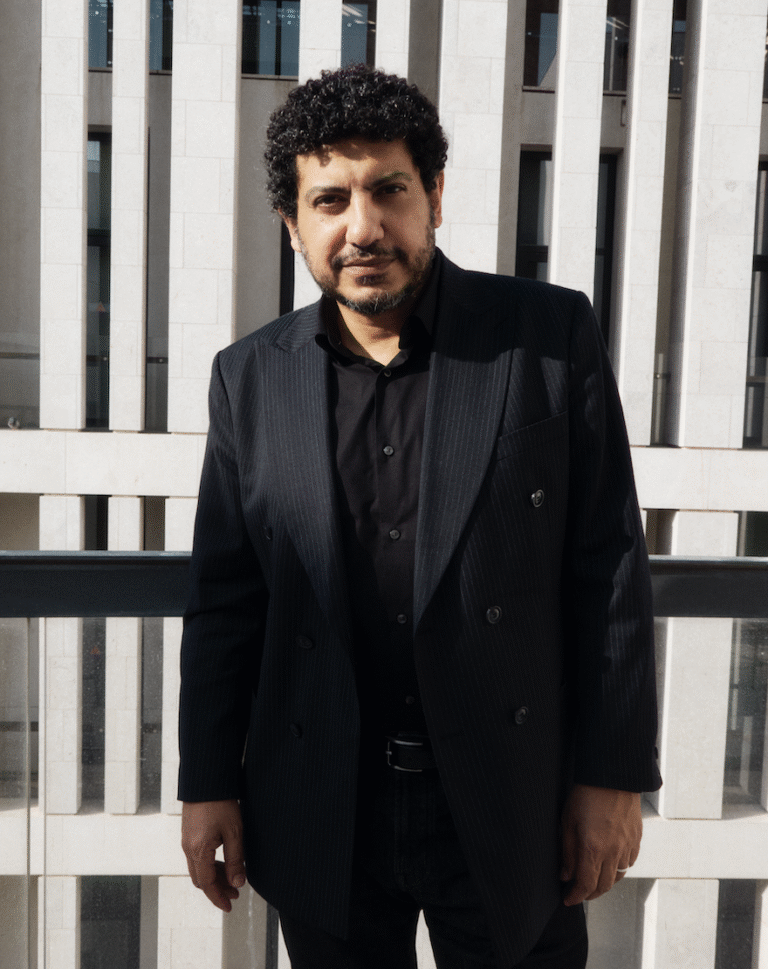

As the sun set on the third day of Art Basel Qatar, the fair’s director, Egyptian artist Wael Shawky, met Marc Spiegler, who led Art Basel’s expansion to Hong Kong and Paris. Looking for a place where Shawky, the man of the hour, could speak undisturbed by congratulatory art world stars from all over the globe, the two ended up on the roof of the Fire Station, the school, residency and exhibition space in Doha that Shawky leads. Over the course of a free-wheeling 45 minutes, Shawky detailed how (and why) he and Vincenzo de Bellis, Art Basel’s chief artistic officer and global director of fairs, worked closely to launch the new-model fair.
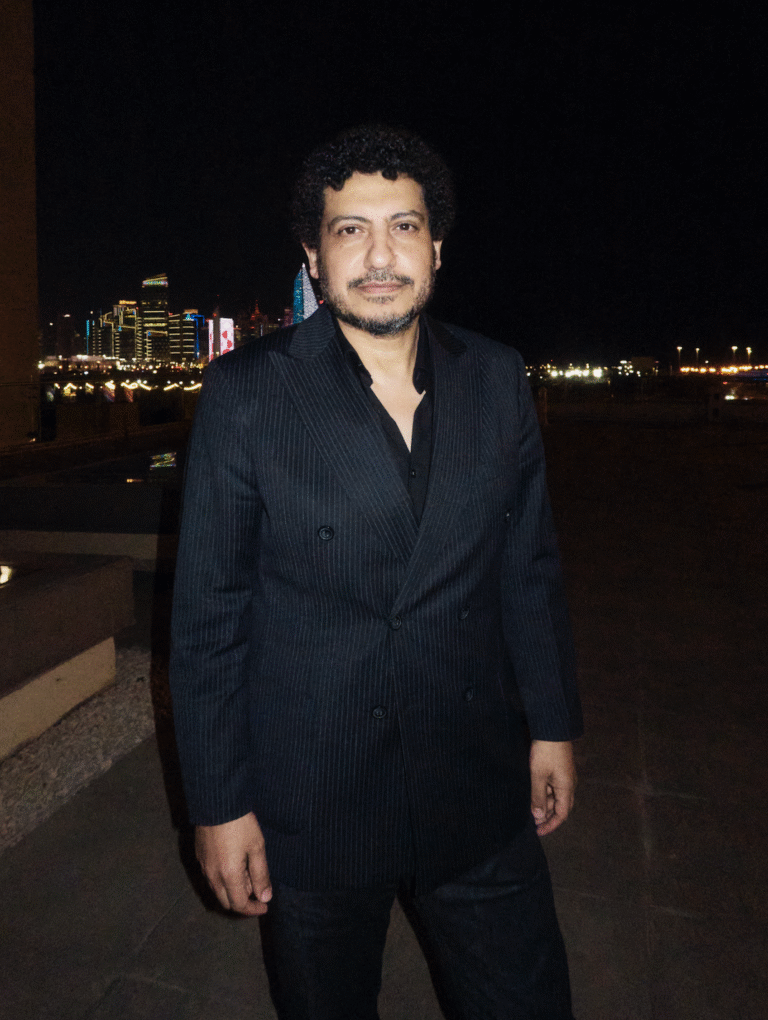
MARC SPIEGLER: First things first, Wael, how did you react when Art Basel first called you and proposed that you could lead the inaugural Art Basel Qatar?
WAEL SHAWKY: At first, I thought, “No!” Because I was extremely busy. I’m currently producing a huge film, which is why I came to Qatar. And then I was asked to lead the Fire Station, which I have set out to turn into a school and exhibition space, trying to establish a new form of education here in the region.
MS: That’s funny to me. Because when I first called Adeline Ooi to run Art Basel Hong Kong, she said, “Marc, I think you’re crazy.” And then she basically hung up on me.
WS: After a lot of thinking about the proposal, and many discussions with Vincenzo de Bellis, I thought to myself, “Museums are now being established in the region, and we need to complete the cycle by having a professional art market.” But to be very honest, I said to Vincenzo, “I don’t want to be responsible for the success of the market,” because it’s really not my area of expertise. And he was amazing about this, because he knows the history of every exhibiting gallery, so he could support me with that knowledge.
MS: And thus arose the first fair ever led by an artist. How do you think that you being an artist is reflected in the new-model Art Basel Qatar?
WS: The beauty about being an artist is that you need to create something completely outside the frame, right? So I dealt with creating this art fair as yet another art project that I’m working on. You know, with most of my films, I make everything. I compose the music, I write the script, I make the scenography, and I try to make many, many different elements — like masks and marionettes. Each piece involves a lot of creativity by itself, and then I work to have everything make sense together. In the case of Art Basel Qatar, it was somehow easier, as the elements were already created by amazing artists, and I just needed to create a structure where they make sense together.
MS: Historically, are you the kind of artist who goes to fairs or avoids them?
WS: No, I don’t go at all. I hate going to fairs. Of course, I like galleries to sell my work. We need to have money from the sales to fund the production. But often the galleries take our work and present it for sale without really presenting the work’s narrative. So most of my artist friends feel completely detached from art fairs. And actually, that’s another reason why I thought it would be amazing to direct an art fair. So the idea was very, very clear for me that for this first edition, I wanted to bridge that gap between the process of creativity and the professional art market. The idea was to raise this idea that the fair’s not only a marketplace, but also a platform for intellectual discourse, similar to what is happening here at the Fire Station. And now this is reality.
MS: Obviously, this fair marks an inflection point within the development of the broader Middle Eastern art ecosystem. How did you think about the impact when preparing the fair? What were you hoping for on that regional front?
WS: I mean, I’m coming from Egypt, and there, as an artist, we’re missing everything. We don’t have one contemporary art museum. We don’t have a professional art market. But we have a lot of talents. Yet you need an infrastructure to really make an art ecosystem exist. Go back 25 years and there was nothing much here in Qatar in terms of the art world. And now everything is happening, really growing fast. That’s why the fair’s theme, Becoming, is the metaphor of humanity developing toward a higher system. Changes are now happening in the region — really huge changes — and it’s fantastic. The vision Qatar has, and the potential here, is really great for me as an artist and as an educator. I am expecting that five to 10 years from now, this will be a center for everything in the arts.
MS: This is a fair which is unique within the art world for three reasons. One is it has a theme, Becoming, as you just mentioned. The second is that you have a relatively small number of stands, barely 80 compared to the usual hundreds. And the third is that it’s only solo shows, even for the megagalleries. I’m curious how involved you were in the process of these three things being decided?
WS: From the beginning Art Basel wanted to make something unique, so I cannot take credit for this. And when they told me that, it was very encouraging and it felt like an honor to be part of creating it. Because it needed to be a statement — a statement that in the Gulf, in general, and Qatar, in particular, the art world is not only about money but even more about quality. Another part of making this fair completely unique was to have half of the artists coming from the MENASA region — meaning Middle East, North Africa and South Asia — because in most fairs, these artists are not present enough. Art Basel Qatar needed to be a place which is inviting all these different voices and cultures, not only the big names from Europe, the UK and the United States. And what’s really exciting is that as part of this statement we had all these special-project commissions — 9 in all by artists including a few international figures such as Jenny Holzer and Bruce Nauman, but it was largely artists from the region such as Hassan Khan, Rayyane Tabet and Khalil Rabah.
MS: In my experience as a fair director, there was an enormous moment of relief when the fair opened. Because from that point onward, you’re no longer in control — the galleries and the collectors are the ones who determine the fair’s success. Were you relieved when the fair opened?
WS: Yes, but not as much as when I’m premiering my own films or plays. Because it was already clear to me one day before the opening that it was going to be amazing.
MS: You were part of a truly historic event for Art Basel and for the region. What were the most interesting reactions to this fair that you got in the last three days in terms of the future?
WS: I heard many people saying that we must change the whole format of the art fairs. Because, of course, we as artists were always complaining about fairs, but nothing was changing. And the collectors here are also happy that at Art Basel Qatar they can see the work better and spend more time understanding each artist. Really, my hope is that this first edition will be really considered as a starting point to change the market in terms of fully respecting the process of our creativity. I will be very happy if five years from now, I go to art fairs and I feel like they’re showing my work just as if I”m showing in a museum or biennial exhibition.