
It’s the fifth and final game of the 2024 WNBA Finals. The Minnesota Lynx are at the New York Liberty’s Barclays Center. The decider. The score is tied 60-60 as the game heads into overtime.
Sabrina Ionescu dishes the ball to Leonie Fiebich, who drains a quick-release three. 60-63. The sold-out arena is on its feet. On the next possession, Nyara Sabally anticipates a loose pass to the Lynx’s Napheesa Collier, stealing the ball for a fast break up the court and scoring an easy layup. 60-65. The crowd erupts; all 18,000 people seem to jump out of their seats at once.
There to witness the moment are Liberty legends of yesteryear Swin Cash, Teresa Weatherspoon and Sue Wicks sitting courtside, not far from high-profile fans including Spike Lee, Jason Sudeikis, Aubrey Plaza and Jadakiss. The question hanging in the air: Could this be a historic victory for the home team?
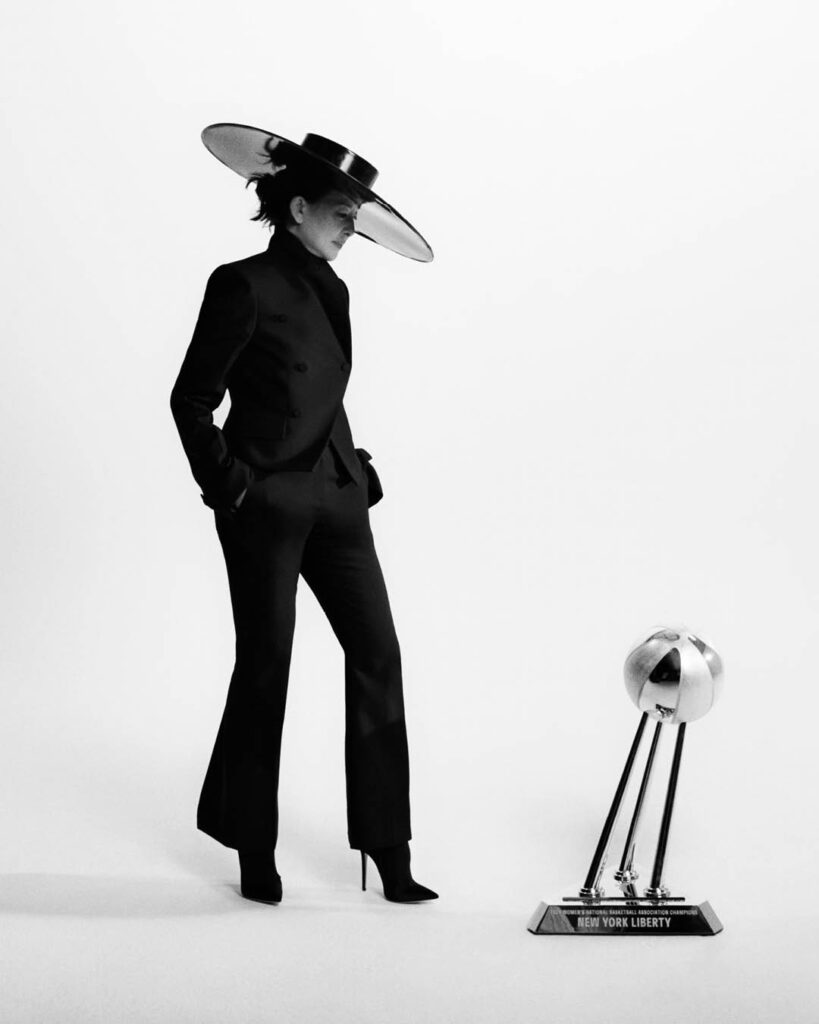
Minutes later, the Liberty answers by clinching its first WNBA championship, which had proved agonizingly elusive for the team founded as one of the league’s original franchises in 1997.
The win underscored the Liberty’s role in a year that saw women’s basketball become a global cultural phenomenon. Stadium attendances, TV viewership, and team valuations all soared. The Liberty’s season ticket membership went up 152% and attendance at Barclays Center increased 64% year on year. In 2024, it set the highest playoff gate revenue in WNBA history. Added to this is a stream of investment from major commercial partners that continues to pour into the sport. By all public accounts, the New York Liberty is now worth $200 million (though reps won’t disclose official financials); when it was purchased through BSE Global, the parent company that owns the Barclays Center and the Brooklyn Nets, in 2019 by billionaire couple Clara Wu Tsai and husband Joseph Tsai, it was valued around $15 million.
In October, days after the win, adoring fans lined the streets of Brooklyn and Manhattan to get a glimpse of the team’s ticker-tape parade and celebrate the championship win with stars like Ionescu, Breanna Stewart and Jonquel Jones, all of whom had forever written their names into New York sporting history. They were joined on the open-top bus by Ellie the Elephant—one of the only mascots in sports history to have gained a following so robust she brings in revenue. As basketball’s sassiest and most-beloved mascot, she was the face of the Liberty’s Lyft and Xbox brand sponsorships last season, and she garnered a dedicatedNew York Times profile in 2023. Last year, she pulled up as a special guest, along with rapper Lil’ Kim, for the grand opening of fashion brand Telfar’s first brick-and-mortar store. Confetti rained down as cheers were sent up for what felt like the beginning of a new era in basketball.
The Meaning of Liberty
Now, at the start of the 2025 WNBA season, defending a championship for the very first time, the New York Liberty finds itself navigating the winds of sociopolitical change in America. Everything the team and the league as a whole stand for—the sporting excellence of women and the spirit of inclusion—is seemingly increasingly under threat. Since the Liberty’s championship win in 2024, the Trump administration has continued to roll back protections for women’s rights and people of color, while major American companies opt to dismantle their DEI programs.
Founded on diversity, the New York Liberty has stayed true and consistent to its values—no matter the political climate. The team represents Brooklyn, a New York City borough where more than 200languages are spoken and which is among the most racially, religiously, and ethnically varied areas in the United States, according to the US Census Bureau. “If you’ve been here, it’s a melting pot of people, and we want to represent our community and our fan base in all aspects of the business, including our organization,” said Wu Tsai. This means inclusion is woven into every layer of the organization—from ownership to front office, star players to athletic trainers and arena staff. It has also built a pipeline designed to elevate anyone at every level, no matter who they are, using rotational fellowships and executive training programs.
“When you have representation, it does allow a deeper connection to the fan base. It allows us to home in on instincts about what will resonate with our fans and how that comes to life in the game presentation and our fan experiences, whether it’s [what’s shown on] LED billboard or the music or theme night.” And it’s a winning formula.
Humble Start
In 2019, when Wu Tsai and her husband, Joseph, co-founder of Chinese e-commerce giant Alibaba, decided to purchase the New York Liberty, they were criticized.
The previous year, the team’s then-owner, James Dolan of Madison Square Garden Entertainment Corp., moved the team from the 19,000-seat Madison Square Garden in Midtown Manhattan to the Westchester County Center, a mere 5,000-seat stadium 40 minutes outside of the city.“And at that time, attendance and revenue had been declining, and the team had been losing money for years,” said Wu Tsai.
But, like the visionary entrepreneur she is, she saw something greater.“There was the opportunity to showcase the world’s best female basketball players in the basketball capital of the world and in the largest media market in the world. So it was a leap of faith, but we decided to treat it like a business and to put resources into it.
Building a New York Dream Team
Every historic team has its stars. For the Liberty, it’s Stewart, a WNBA stalwart, two-time MVP, and serial record-breaker; Ionescu, one of the greatest shooters in women’s basketball history; and Jones, a four-time WNBA All-Star and domineering center whose standout showing across four games against the Minnesota Lynx saw her awarded the honor of 2024 Finals MVP. Together, the Big Three, as they’re called, are a force.
And behind the triumvirate’s construction is the foresight of Wu Tsai. For her, these three players formed the culmination of a multi-faceted effort to assure the team its rightful glory and return it to what it was in the late 1990s and early 2000s. But to make it happen wasn’t exactly a breeze. Just securing Stewart alone meant tracking her down on a yacht in Turkey to make a recruiting pitch, a move only possible by seizing on changes to the 2020 collective bargaining agreement that relaxed restrictions on player movement.
“This was a four-year process,” Wu Tsai said of building her powerhouse crew. “It didn’t happen overnight. It started by moving the team to the Barclays Center, then, in 2020, when we had the number one draft pick, selecting Sabrina Ionescu, who was widely considered a generational talent and had broken all kinds of NCAA records for men and women,” she said. “Sabrina was the cornerstone, and over time, through trades and free agency, we slowly built a team of stars, including Betnijah Laney-Hamilton, Jonquel Jones, and then, of course, Stewie came.
In March 2025, the Liberty announced plans for a new $80 million state-of-the-art practice facility in Brooklyn, incorporating player insights from Ionescu, Stewart and Jones, underscoring Wu Tsai’s commitment to building a basketball dynasty out of New York for years to come.
Cultural Changemakers
When speaking to its players, it was clear that their pride was rooted not just in clinching New York’s elusive WNBA championship—after falling agonizingly short in 2023—but also spearheading the soaring cultural impact of women’s basketball. “I’m pretty sure Sabrina and I are the only players from the same team to both have signature shoes in the WNBA,” Stewart said.
The Liberty’s players also spoke of a genuine desire to build a legacy that set up the next generation of women’s basketball players. “When I was younger, it was harder to watch women’s basketball and find those players to look up to, so my role models were people like Dirk Nowitzki and Tim Duncan,” Stewart said. “Now, young kids can go into stores and see [products from] Sabrina and myself… They’re able to see JJ showing up in commercials.”
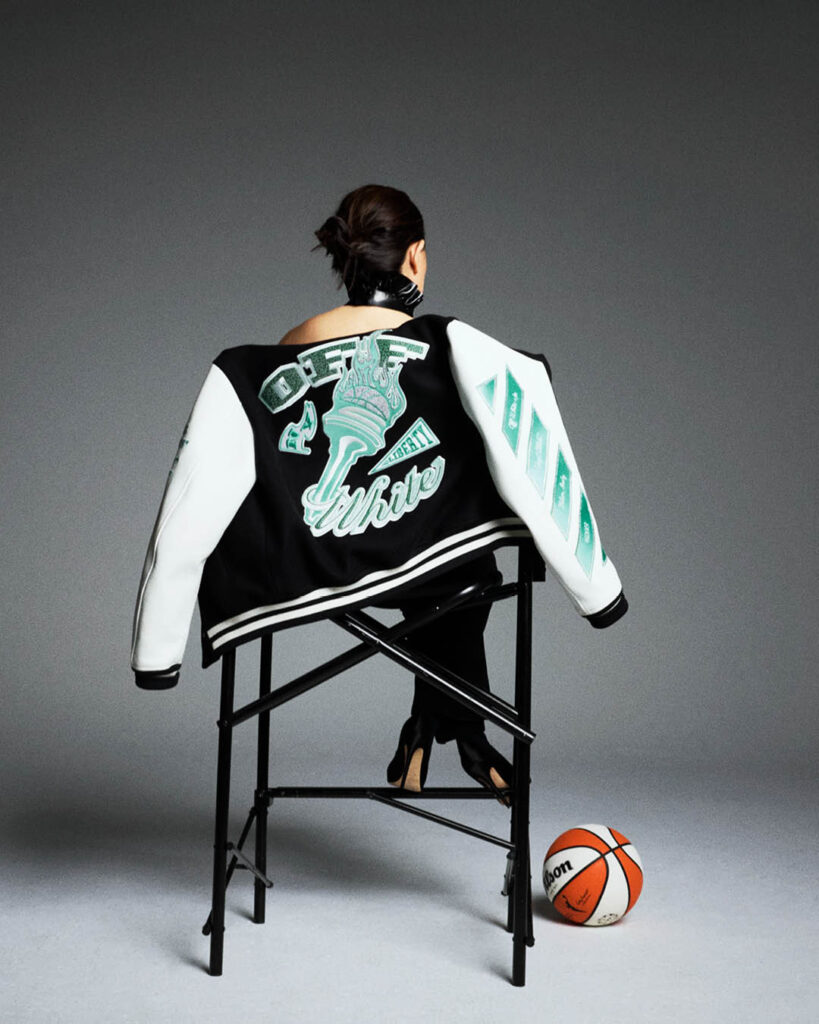
Those young kids are also able to see their favorite team represented in other cultural channels, too. In September, the team launched a new partnership with luxury streetwear label Off-White, which became the Liberty’s official style and culture partner, the first deal of its kind in the WNBA.
For Ionescu—whose Sabrina 2 sneaker became the second-most worn silhouette across the NBA in 2024 and a top-seller in Nike’s competitive signature category—creating products as a female athlete is a fundamental part of moving the game, as well as society, forward.
“What we wanted to create was a shoe that wasn’t simply seen as something designed by a woman,” she said. “It’s just a great basketball shoe worn by everyone, men or women.”
The cultural shift has been felt the most by the players who worked for so many years, often away from the spotlight, without ever losing their unwavering commitment to being elite athletes and performers at the highest level.“The special thing that’s happening in the WNBA is that the talent we’ve always had as professional athletes is finally being seen, because there is now an acceptable amount of respect for women’s sports,” said Jones (who wasn’t available for this PLAYERS shoot because she spent the offseason in China, playing for Sichuan Yuanda).
On a personal level, Jones is still processing the pivotal role she came to play in the Liberty’s championship win as Finals MVP, after a career in which nothing was ever promised to her. “Being somebody that played at a small D1 school with basically no national attention, then being drafted to a smaller WNBA organization,” she said, “I fully thought (and had accepted) that my career would be defined by taking the road less traveled.