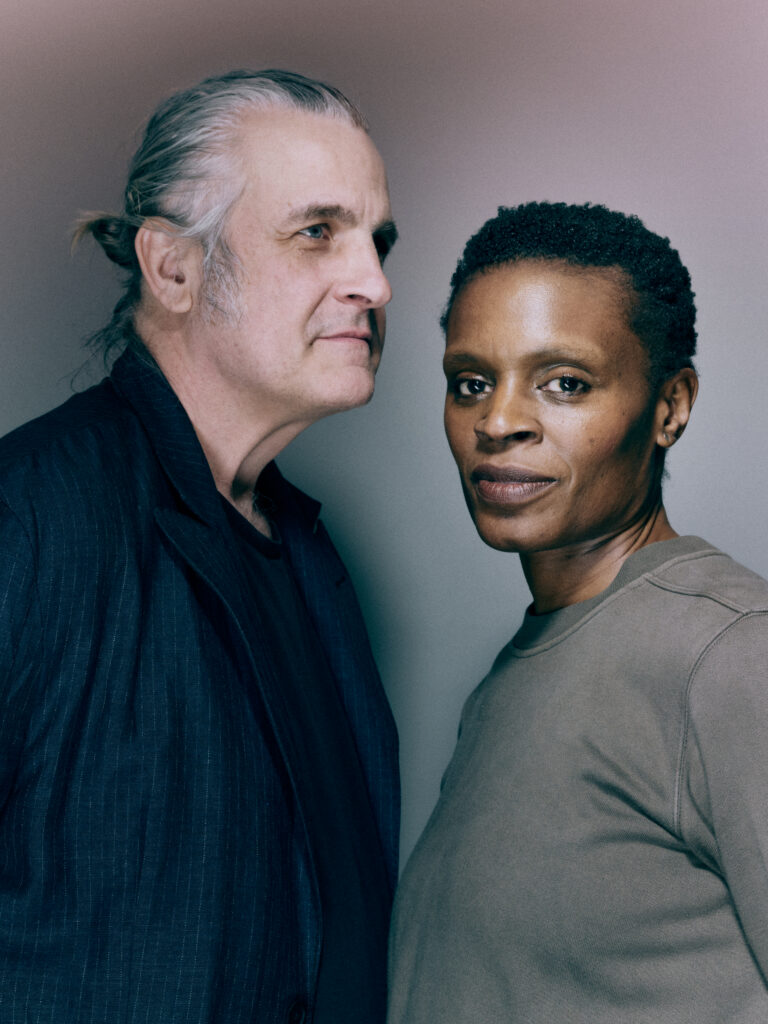

Okwui Okpokwasili’s choreography, met with Peter Born’s scores and structures, has the cosmic quality of steps traced through centuries. Her movements carry open-ended narrative possibility, either expressing or protecting a memory, intention or construction; every moment of every work the duo creates is heavy with meaning. Okpokwasili doesn’t pull from her own memory alone but from ancestral memory.
She moves in unison with the unseen, collecting and dispelling energy through her arms, thighs, neck, stomach and fingertips. To watch her dance is to feel yourself looped into a weighty and simultaneously immaterial tapestry. She stretches, constricts, reaches, recoils, vibrates and rests. Each movement flows into the next, whether with a sense of force or ease.
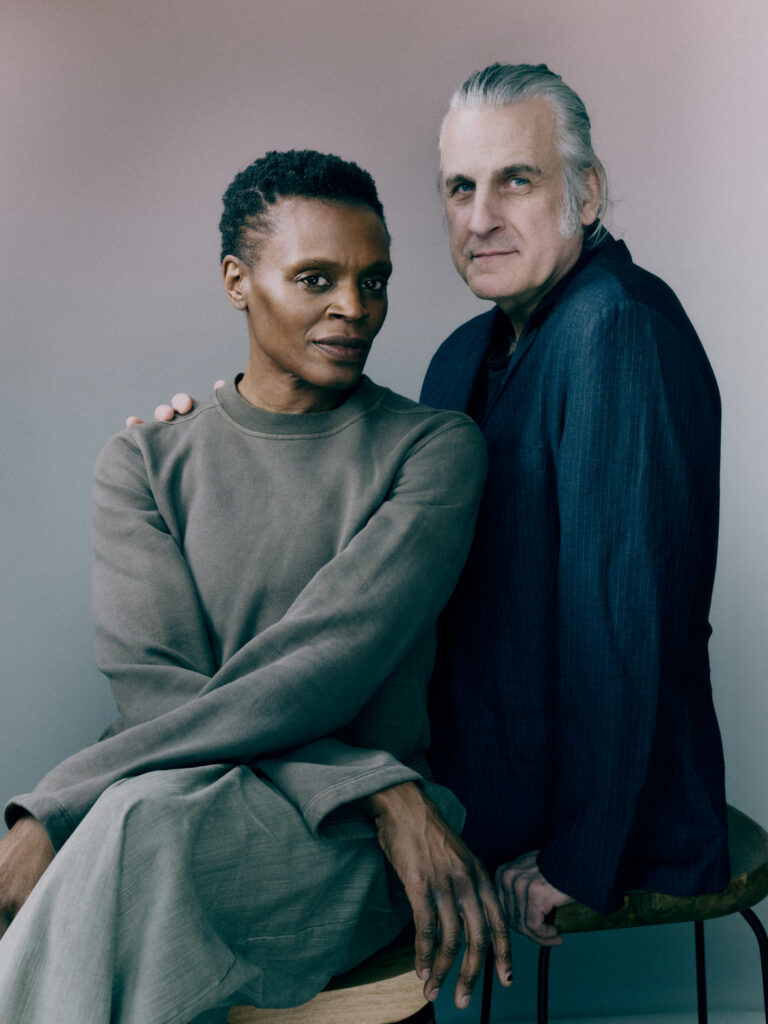
Okpokwasili’s movements read as those of a medium, channeling a consciousness that extends dizzyingly in all directions. She and her partner in life and art, Born, move and make music with a raw and rare spiritual sensibility. In movement, they receive, acknowledge, interpret and disseminate knowledge that cannot be put into words: messages from the past and the future wrapped into the present. On the occasion of their performance my tongue is a blade at Art Basel Qatar, we discussed time, feeling and the beauty of the non-linear.
Camille Okhio: Let’s start with the work. How was the performance? How did it feel for you?
Okwui Okpokwasili: This work demands something from the practitioners, from us. I’m always really excited and moved by that. It’s an interesting way to send something — a charge, a vibration — into the universe.
The work is called my tongue is a blade and it’s performed with a circular structure of 36 plexiglass mirrored panels. One of the performers is always pushing it. Inside of it there is either a duet or a solo. People witnessing it are also being reflected back to themselves in the mirrors; they are a part of it.
Inside of the structure we “practice” both solos and duets. In the solo you are always trying to remember where your partner was, where they were in your body, what the contact was, what the charge was. Even in your solo, you’re still dueting with the presence or haunting of that person who was your partner. It’s about holding on even when we are alone.
In framing it as a practice, the performance becomes constant.
CO: Thirty-six mirrors and a duration of three hours: Is there a symbolism in the numbers used within this piece?
OO: Even though, obviously, three is a magic foundational number, there is no symbolism.
CO: Where did the title come from?
OO: I did a sightline for an exhibition at the Bard Graduate Center [“Sightlines: On Peace, Power & Prestige: Metal Arts in Africa, curated by Drew Thompson”]. In the exhibition were these axes and blades in the shapes of tongues that were made by an ethnic group in Nigeria I had never heard of. They were ceremonial weapons used for people who have spiritual or oracular powers. Even just working with fire and metallurgy hinged on the divine, because you are working with a primal substance and using it to transform and change things. I loved this idea of the tongue as a blade and what it could do. I was thinking about women and the tongue. I was also thinking about the Bible verse that says something like “take care because your tongue is a fire.” [Proverbs 18:21 states, “Death and life are in the power of the tongue.”] It is the most dangerous part of the body.
CO: I think also about the loss of the tongue –– the power of it. How much was this piece inspired by grief? Longing? Separation?
OO: I think everything I do is inspired by grief, or more so a separation between the memory of my own past and my own Igbo heritage. The Biafran War created this rupture and the post-colonial rupture, as well. There is a grief and longing around what I don’t have of the Igbo language, around addressing some of the ruptures in my own family and in our experience of Igbo culture. And then here in the United States, the grief and the pain around what I have experienced or seen with Black women and African women, not just in my family but in some of the neighborhoods I grew up in. For girls of color in the Bronx in the 1970s and 1980s, there was so much violence happening against us, to us, sexual violence, psychic violence — the way the world was prescribing who we were and who we could be.
We were left to our own devices to fight in a world that was really violent toward us, that violated us. I remember in elementary school the amount of times I saw girls and women assaulted and not having the language for that. I have grief for those girls and the girls that we were. Now the grief is so overwhelming because of the obvious attempts of the most powerful people in this country trying to erase Blackness and suggest what is American and what isn’t.
We know what’s happening in Minneapolis and Gaza and what’s happening in different parts of the African continent that we don’t even talk about or look at. Whose bodies are figured into the human calculus? There is grief and a desire for some accounting for all of the bodies.
CO: How do you track, process and express that grief in other works?
OO: The adaku series that you saw part of is a trilogy about the entanglement of one girl into the slave trade after an argument that starts in a West African village. I was trying to track a thread through time: the memory of this initial rupture in this fiction. The first part takes place in the African village. A rupture happens and a girl is taken into the slave trade. Something happens with her hair and she starts to grow antennae and has this memory of the past but also a memory of the future. What would it be like if we could explore memory in our bodies? How do we trace it? Is it coming through the crown of our head? Is it coming through our belly? Is there some sort of global memory or cellular memory that could open up and come in through that space?
CO: Have you given thought to the nonlinearity of time? There are West African theories on this that I find increasingly compelling, especially as linearity clearly serves capitalism and profit above all.
OO: I think about the stars. When we look at them, we are seeing the past, but are the stars sending out a signal that gets to us in the future? The star isn’t here, but it is… The light is here with us, so it exists in the past and the future.
In Igbo culture, certain masquerades and rituals allow for communication with the ancestors, and there are certain spaces you go into, particularly in the bush, where that line between the living and dead is very porous, and you can easily fall into this other space. There is also this ongoing conversation that has to do with thinking that death is not this final veil or this door that shuts everything down. I do wonder if there is another plane or some transition space, who might have access to it, and what would communication look like from this living plane to the transitional space to the space beyond the traditional space? Where are the leaks? And do you have to be trained to access that?
CO: Your work feels to me so deeply about connection. Can you speak to your origin story with Peter and your wider thoughts on romantic connection? How did you two meet? How does your partnership work?
OO: We met at Yale as undergraduates. We started to work together. We were friends before lovers. We met before cell phones, before any social media. There was only connection.