

Soccer fans may be the most tribally loyal consumers on Earth. They will follow a club through relegation, insolvency and even decades of mediocrity without questioning their allegiance. That loyalty has historically been monetized at its crudest: a polyester shirt, a scarf or a mug. Fans buy club merch to express allegiance — but it isn’t what they’d choose. By and large, their appetite has proven to be in the streetwear drops and luxury collaborations of contemporary fashion. The space between what clubs sell and what supporters actually want is vast, largely ignored and still mostly unclaimed.
Enter the soccer club’s creative director. A role once reserved for luxury houses, it has been adopted by more and more forward-thinking clubs ready to bridge the gap. What this role demands, however, is more exacting than it appears. It is a form of editorial archaeology: extracting the irreducible truth, cultural texture and mythology of the place a club represents, and shaping it into a coherent, ownable identity. From there, it must be translated into a universe of products and experiences that a more discerning consumer — attuned to the difference between generic and meaningful design — would actually choose.
Recently, smaller clubs have become testing grounds for this growing concept. By leveraging the power of place to inform, and build, a club’s brand (think: Paris, Venice, Athens), creative directors are attracting fans to a place and a lifestyle rather than attempting to draw soccer fans to a team that has become stagnant.
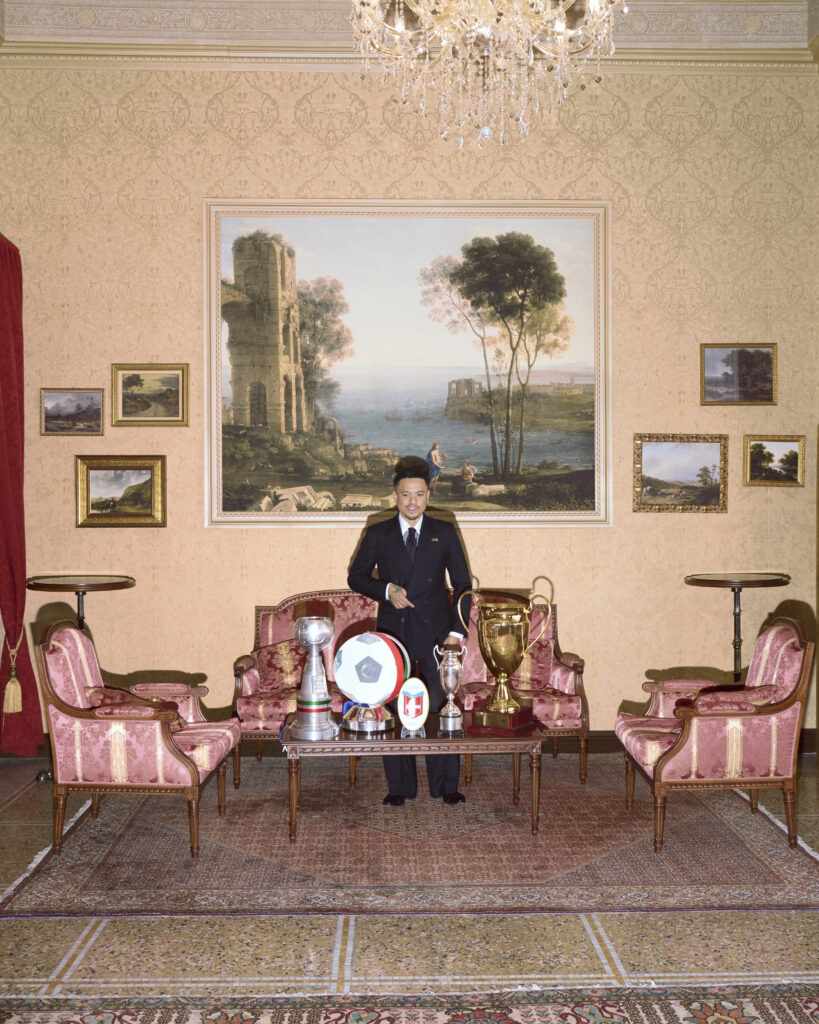
This is what makes Como 1907, in Lake Como, Italy, a revealing test case. Few places in the world are as immediately legible as an idea as Lake Como — the lake, the villas, the Alps at dusk, the particular quality of an afternoon that does everything in its quiet power to argue against urgency. The harder question is whether a soccer club that has limped through relegation for the last 21 years can be reborn to genuinely inhabit all of that, or whether it will merely decorate itself with the setting.
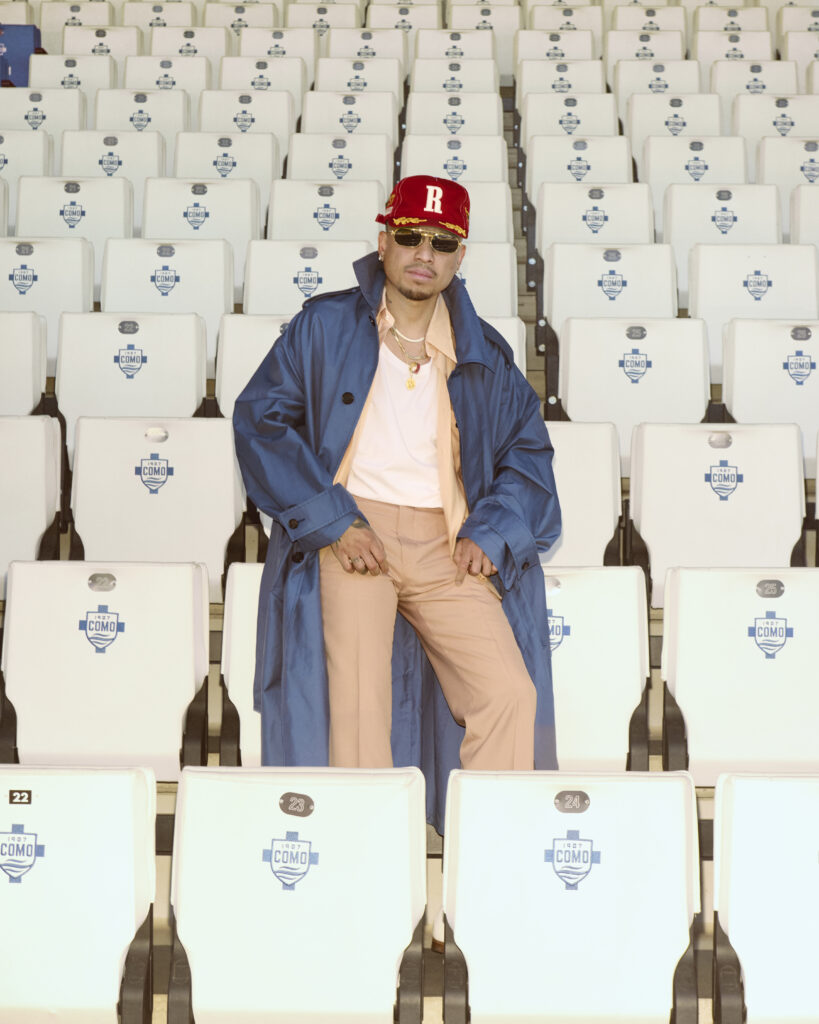
The answer, in this case, will come from Rhuigi Villaseñor, the club’s chief brand officer and minority owner. Founder of RHUDE and former creative director of Bally, Villaseñor has been tasked with building a global identity for a club with limited international recognition and positioning it, in the words of president Mirwan Suwarso, as a soccer lifestyle destination. Few operating in this space have been given comparable latitude, and fewer still are as directly invested in the outcome.
Proof of Concept
What distinguishes Villaseñor’s role is not only its scale, but how it extends beyond Como 1907. RHUDE 4 FANS — a platform conceived to reposition fan apparel as a premium, design-led business — operates alongside the club as a separate initiative. RHUDE 4 FANS produces capsule collections for clubs including Everton, Tottenham Hotspur, Los Angeles FC and Al-Ittihad. This means that fans of Como 1907 will buy into a branding spread across clubs, again testing the logic of the great experiment.
The timing is deliberate, too. A specific tier of club has begun to recognize an opportunity the global giants have been slower to pursue. Not the dominant institutions, but those operating just below them, those that are culturally situated and structurally freer. Increasingly, these are the clubs whose brands have moved beyond sport: their kits stocked in concept stores, their campaigns moving through fashion networks, their identities discussed independently of results. These soccer clubs are building relevance through brand coherence — a point of view rooted in place and expressed consistently across product and image –– rather than trophies.
Fashion Tangent No More
Luxury houses have long dressed teams off the pitch — Zegna, Louis Vuitton, Dior, Off-White — extending prestige without materially reshaping the club itself. Even the more authentic collaborations, such as Héctor Bellerín’s work with 424 at Arsenal F.C., remained contingent on individual relationships rather than institutional change.
Players, for their part, have always expressed style on their own terms — from Johan Cruyff to David Beckham to Paul Pogba — but these gestures were personal, not structural. They could not be scaled. What can be scaled, it turns out, is the identity of a team and a place.
The modern template began at Red Star FC, where former Manchester United F.C. striker David Bellion treated creative direction as strategy rather than embellishment. By placing the club’s jersey in Paris concept stores alongside fashion labels, he reframed what a piece of club merchandise could be and who it was for. The approach created visibility, but it also created tension, as fans, and the press, started to question the balance between cultural ambition and local identity.
That tension remains unresolved. It is managed, rather than solved, by anchoring identity in places with enough cultural weight to absorb reinterpretation. At Venezia FC and later Athens Kallithea FC, creative direction translated local mythology into visual systems that extended from kits to campaigns to partnerships. In 2023, Crystal Palace FC appointed Kenny Annan-Jonathan with a mandate to reach a fan for whom allegiance is no longer inherited but chosen.
The premise underlying all of it is straightforward: the space between performance merchandise and genuine luxury has never been fully occupied. The modern fan, increasingly fluent in design and culture, expects more than symbolic affiliation.
The Como concept, a brand designed toward regional identity, and soccer fans who exist in a modern fashion landscape is where it all comes together. RHUDE 4 FANS is how Villaseñor intends to extend it.
We met him in Milan to put that ambition to him directly.
Christopher Morency: Rhuigi, being between the worlds of fashion and sports, what’s something you believe the fashion industry can learn from sports?
Rhuigi Villaseñor: Loyalty to the brand. With sports clubs, whether it’s ticketing or merchandising, you always know what you’re going to get. That consistency is what builds loyalty, and through that loyalty, they keep gaining new fans, new customers. In fashion, it’s very seasonal. A lot of ups and downs. With sports, success is also directly correlated to performance. How do we get the athlete to move faster and achieve more? In fashion, innovation comes into place every five to 10 years. It’s still very led by trends, and as much as we want to be at the forefront of it, we’re on the reactive side rather than the proactive. In sports, it’s the other way around. In sports, it’s like science: How do we get athletes to perform like a rocket ship? But both sides can learn from each other.
CM: Tell me about how you got the Como job?
RV: In 2024, I had an opportunity to become a shareholder of Como FC and also sit as chief brand officer to propel and accelerate the growth of the company. I don’t even want to talk about myself as a fashion designer, more like a social studies professor, logging what’s needed in a moment. When I came in, I looked at the IP of Como and thought about how the sports I grew up with (the NBA, F1) were able to monetize the symbiosis between the teams and their cities. How could we use the team as the capital of the town, and how do we translate that into merchandise? Tourism is the big key here. With Como, roughly over 60% of our season-ticket holders come from all over the world. In my dream, I want to make product that competes with LA and New York. Not so much the sports, but in terms of interest in the cities themselves.
CM: You mentioned the NBA — how does that league experience shape what you’re building now?
RV: In 2020/2021, we [at RHUDE] partnered with the LA Lakers, and what I learned was that in the middle tier of products there’s a hole in the business, a space where sports merchandise and luxury brands aren’t meeting. Whenever a luxury house meets with a sports club, it becomes this one little moment instead of a lasting thing. Through the Lakers experience, I learned what’s needed. So we created R4F (RHUDE 4 FANS) under the label RHU. It’s focused on multi-club servicing. How can we build small joint ventures with [clubs]? That will sit in the middle tier. It’s an opportunity for the teams and clubs, not only in merchandise dedicated to the field or the court, but something that dances in between the fine line of luxury, which is very conceptual, and sports, which is mainly performance. We’ll land in the middle tier. Same with pricing; we called it “gourmet.” It’s not Michelin, but it’s there. It will be democratic and friendly and speak in a new language where I think a lot of the sports partners are incapable of doing it because they’re so massive. I want to dedicate designers to each club so it feels more bespoke. We have Tottenham Hotspur, the Dallas Mavericks, and Everton to name a few. We’re looking to grow in all fields; we have representation in the Bundesliga, Serie A and beyond.
CM: How does all of this connect back to the RHUDE universe? It feels like Como and RHU, your Zara collaboration, are a natural extension of the brand’s DNA rather than a departure from it.
RV: It’s been a natural growth. For RHUDE, it’s the American dream: A young man moves to America and has an idea of what a luxurious life there will look like. One of the first places I went after I left the country was Lake Como. It’s been pulling me back ever since. A lot of the aesthetics RHUDE carries has a throughline with F1, cigars, Europe, all the way back to the ’50s.
CM: Why do you think we’re seeing the overlap between soccer, and sports at large, and fashion now so prevalently?
RV:
I think what’s happening now is that, overall, fashion is struggling. Young people are pushing back on what luxury even needs to be and the way it’s produced. What I’m seeing is this challenge to the very idea of what luxury is — it’s a reflection of what the market is. Now, it’s more about community. Once a collective of people believe in something and follow it religiously, that’s the most powerful thing. Sports is the closest thing to it. Now, we’re at the beginning of that fine line being broken.
In general, people like to label things for their comfort zone, but it’s like our bodies. To say that our lungs work differently from our brain doesn’t make sense. It all belongs in one body. For one to function, the other has to operate as well. Now we have the opening of doors in fashion. Fashion is no longer a subculture. As companies require more revenue, you can’t rely on subculture alone. Products we used to look at as exclusive have to reshape what that means, and what luxury means.
CM: Back to Como. What does the full Como experience look like in practice? What are you actually building on the ground there?
RV: We try to be a one-stop shop where we offer the entire weekend through our tourism and hospitality arm. You’ll get the boat, the aperitivo at Casa L’Acqua, an Aperol spritz, watch the game with the blessing of our great coach, Cesc Fàbregas, all with these picturesque views in the background. We want to present exciting football, mimic the NBA during the Showtime era. You might rub shoulders with Michael Fassbender or Natalie Portman or any friends of the club.
CM: How are you thinking about building a fan base from scratch, or converting people who have never thought about Como before?
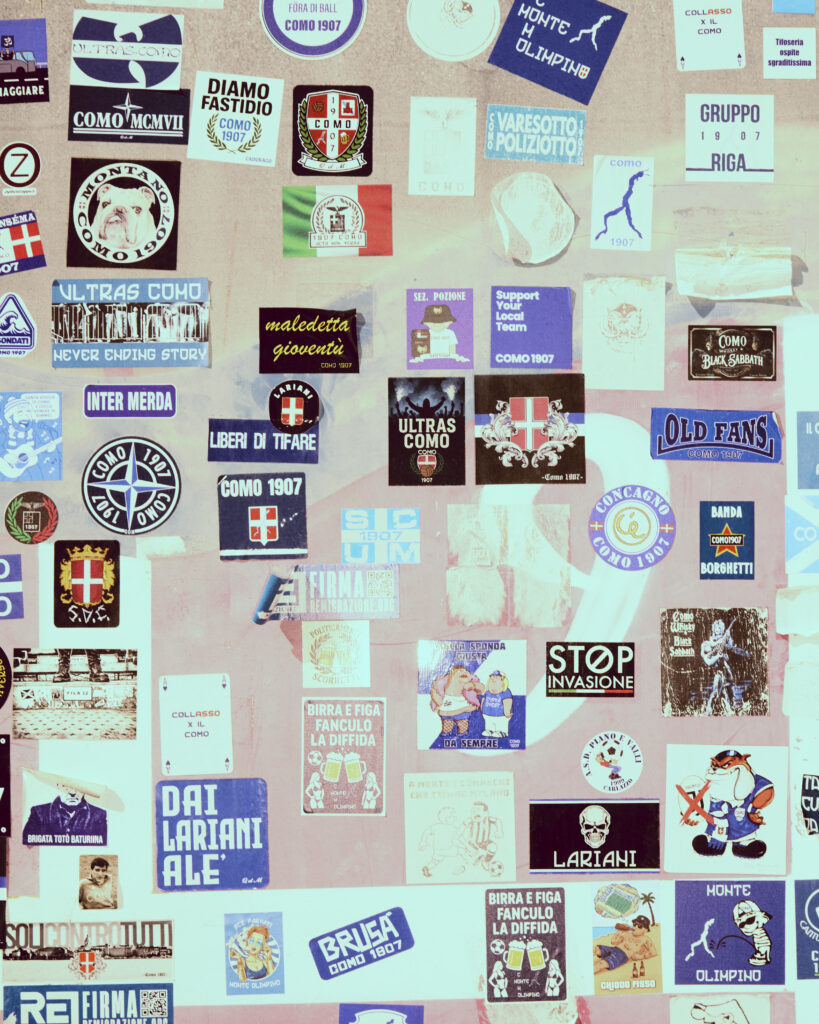
RV: It’s important for us to self-reflect. We’re a growing club. A lot of fans have loyalty to the clubs they already love; we’re an alternative. As we bring in new players and young talent, we’re looking at the long-term project. Young people will see others who look like themselves (16-, 17-, 20-year olds) getting opportunities at Como, and that will grow the community. But I want to grow faster than the success of the club, so we’re looking to create subcultures in different pockets of communities across the world that connect with the fashion side. Like, you’re loyal to RHUDE, you can be loyal to the pitch. Festivals we can throw, aperitivo moments, a multi-faceted club. Eventually a lot of clubs will take the playbook.
CM: It sounds like you’ve been given a lot of creative freedom. How rare is that?
RV: I want to give a lot of kudos to my partners, to the people who gave me the keys to run with it. It’s hard for analytical, statistics-based business thinkers to give what they probably see as dreamers or creative people the opportunity to grow a business. What’s special about my story is that I’m calculated in how we perform. We still need to reach certain numbers. What’s happened in other creative roles is that people may not have gotten much creative freedom, and then they might also not see it the way my peers and I do. We know success needs to come, but we don’t need immediate success.
We’re trying to build real core foundations and communicate them through the world. People come to Italy for pizza and pasta, and my job is to serve that in terms that are palatable but still different from anything else.