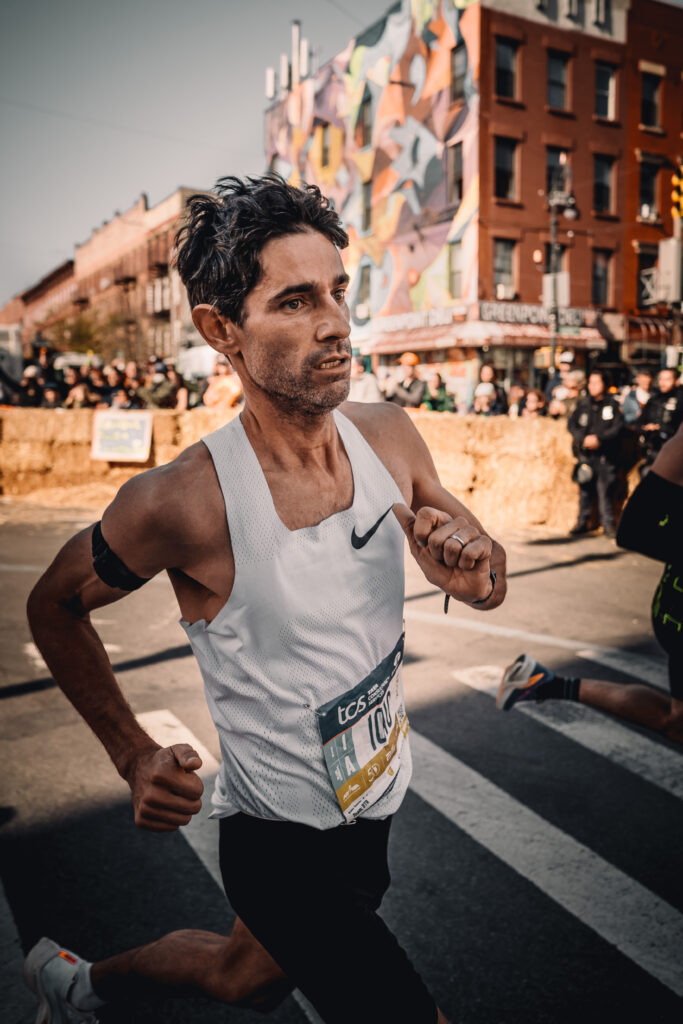

It was just over a year after Thompson’s father died. He was 43 years old and the editor-in-chief of WIRED magazine when he got an email from a team at Nike: They had a new program in the works and, they wondered, would Thompson like to be part of it? Nike’s aim with the program was to link elite coaches with everyday runners, train them for the Chicago Marathon and see what happened.
Thompson was hesitant. His work was demanding. Running, even without an elite coach, was demanding. And he felt like his days of speed were behind him. When he was younger, he’d shown an aptitude for racing, but age and the demands of a full life had taken their toll.
But he was grieving. His father had been the one to introduce Thompson to running. “When you lose someone close, you can hold on through photographs. You can share stories, and you can cry. But sometimes you need to feel the person’s presence, which isn’t easy when the person’s gone,” wrote Thompson in The Running Ground.
While the terrain he had run with his father was long gone — “the dirt roads I had run with my father in Virginia had long since been paved. The house at the farm had collapsed” — the drive to run better, faster and stronger, instilled by his father, was not. Which is where we meet Thompson in the following excerpt: roughly halfway through The Running Ground, when he’s decided to say yes to training with the Nike coaches.
A FEW WEEKS LATER, I got on a conference call with Nike’s three experts — Stephen Finley, a bighearted coach with the height of a basketball player and the patience of a watchmaker; Joe Holder, a physical trainer with the physique of a Michelangelo and the diet of a tortoise whose clients included Naomi Campbell and Virgil Abloh; and Brett Kirby, a sports scientist with the calm demeanor and seeming wisdom of Obi-Wan. I didn’t know it then, but Kirby had designed some of the training for Eliud Kipchoge and can be seen on a bicycle in a YouTube video of one of the great Kenyan’s marathons. People with credentials are often boring or cold. But each of these three men combined kindness with their wisdom. I would have happily left my kids with any of them for a day of homeschooling.
I told them how I’d trained in the past and what my goals were for the future. I explained that my marathon times had been remarkably consistent for more than a decade. I had finished both my first two NYC marathons in 2:43 before Ellis was born. After Zachary, and then James, arrived, I had finished them in 2:42, 2:42, 2:45, 2:46, 2:46, and 2:43. One of my friends gave me a nickname: “Mr. Two Four Three.” I hated it, but it was fair.
I told them that I loved the sport, and I wanted to understand it better. I would happily train smarter, I added, but I didn’t have the time to train more. I sent them a link to my old online logs and told them that I now tracked every run on Strava. I told them that aging made me feel like a tire slowly deflating in the cold. They assured me that with science and a little bit of math, there was a way to pump some air in. They would work up a training program and put it all in a Google Doc. I told them that I wanted to break the idiosyncratic goal of 2:43 because it was two hours, plus my age in minutes. “My dream would be to run under 2:40,” I said with a chuckle, “but there’s no way I could go that fast.”
That didn’t have to be true, Kirby reassured me. As a person ages, he explained, the variables that control how fast we run don’t ineluctably get worse. We often gain weight, but we can lose it again. We pick up bad habits from injuries that change our form — say, a tweaked right ankle that makes us land too hard on our left. But a habit caused by an unconscious choice can usually be reversed by a conscious one. Crucially, as Kirby explained, our muscles change in ways that are both good and bad. Our lean muscle mass declines with age, which is bad for marathoners and even worse for sprinters. We lose what is called peak propulsive force, meaning the power with which we push our feet into the ground. Our maximum heart rate declines. But as we train, over time, the mitochondria inside our muscle cells become more efficient at converting energy. New blood vessels develop. Tendons strengthen. We should, perhaps, get wiser.
Runners tend to decline badly in their 30s and 40s, but the main reason we slow isn’t our bodies. It’s our lives. We get married, we have children, we work longer hours, our parents get sick. We have more pressing things to do with our time. Running is a sport that rewards consistent effort, and once you step away, it’s hard to come back. Your body frays, which makes running less enjoyable, which accelerates the decline. People stop running because they get old; they also get old because they stop running.
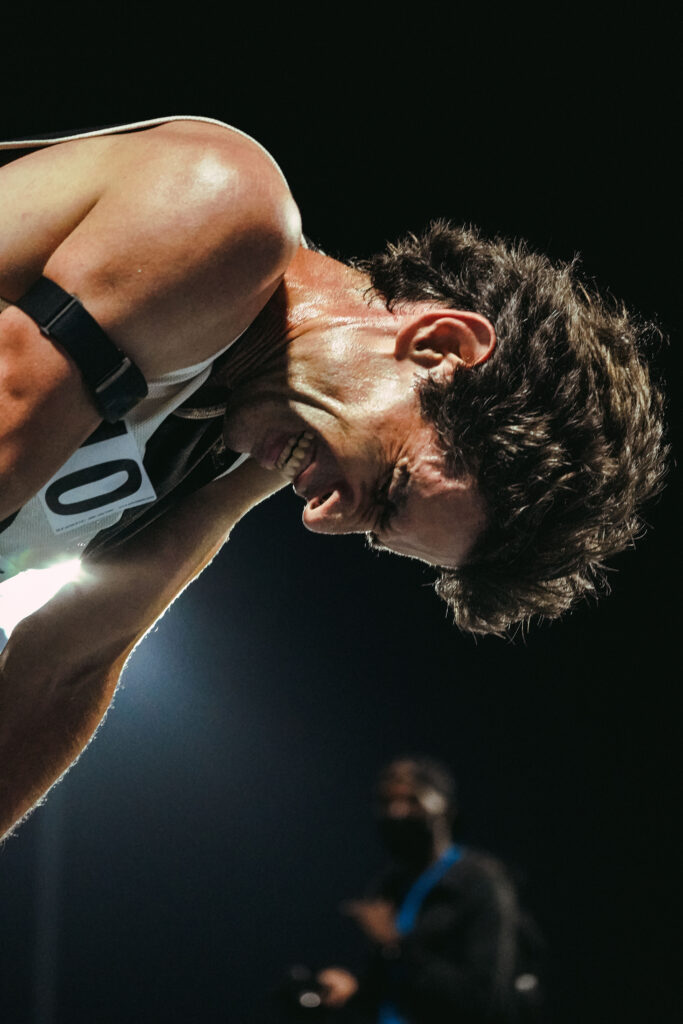
My new coaches listened to my description of the training regimen I had followed through my 30s and told me what it lacked. The long runs I was doing were good. The total volume of training — about fifty miles a week — was OK. Ideally, I’d run more, but changing that variable increases the risk of injury. There was one variable I could truly improve: time spent running fast. I wasn’t doing remotely enough work to improve one of the key metrics of running: VO2 max, a number that describes the body’s ability to move oxygen through the blood during intense exercise. Or to put it in a formula: maximum milliliters of oxygen consumed in one minute divided by bodyweight in kilograms. Nor was I doing enough to improve my lactate threshold, a measure of the body’s ability to move without the amount of lactate increasing in the blood. If VO2 max is equivalent to a car’s engine size, a runner’s lactate threshold is the red line on the tachometer. I needed to improve both.
VO2 max improves mostly through speed workouts — running quarter-miles, or miles, to the point of near exhaustion, resting briefly, and then running them again. Lactate threshold improves most through what are called threshold runs: running at a pace that’s tiring but where you can still talk, at least a little. So, starting in early July, I began a new routine. I still got most of my miles in by commuting to and from the office, which was four miles away, on foot. But on Tuesdays I added focused runs to tax my VO2 max, and on Thursdays or Fridays I added threshold runs. I started doing core workouts that Holder prescribed for me. A couple of times, I met him in gyms in Manhattan and he’d teach me how to properly do exercises I’d long neglected, from airplanes to pull-ups to Z-presses. He was astonished to learn how little I knew and to discover that I had the flexibility of the Tin Man.
Finley became the person I spoke with most. He wrote out plans for every workout in a Google Doc grid, and I would report each day how I’d done. He’d check it every now and then, and we’d talk every two weeks. Within a month, something had started to change. I was running mile repeats faster than I had done since college.
I wasn’t following the prescribed program precisely, because life always intervened. I often had to run with a fanny pack to transport my wallet and keys, or a backpack to carry my clothes, which slowed me down. Sometimes I’d have to join a conference call while running, which slowed me down more. One afternoon when Danielle was working, I took my three sons to supervise my track workout, which was short-circuited when James, then four years old, justifiably declared himself bored and the workout over. Other runs involved stops at the dentist, the dry cleaner, and soccer practice. Red-eyes scuttled planned runs, as did sudden HR crises. But the Google Doc that Finley had made was forgiving. I just had to hit a few workouts precisely in every seven days, and I had to get the weekly mileage roughly right. The rest was flexible enough for a man with a job, who had a wife with a job and three children with whom spending time was always an absolute joy.
The second big change in my routine came from data. I’d long believed that any data beyond the basic was a distraction. The quantified self is often a neurotic soul. For years I kept track of my runs with my stopwatch and guesstimated the number of miles I ran. Kirby persuaded me to break this habit.
Soon I was running with a Garmin Forerunner 935 on my wrist, an external heart-rate monitor attached to my arm, and little pods attached to both my shoes and my waistband that measured my power output and balance. After a run, I’d sync the Garmin and study the data. I now had precise information on how much of my energy had been spent going forward and how much I’d wasted swaying side to side. I could see how my feet had pronated and whether my heart had been beating as fast as it had during a similar workout two weeks before.
Kirby’s training philosophy matched in many ways my favorite philosophy of playing music, often ascribed to Charlie Parker: learn all the theory you can, but forget it when you play. He wanted me to gather data. And he talked to me about “bottlenecks.” Every runner has unique limitations: some physiological, some psychological, some biomechanical. The key isn’t to try to improve everything at once, but to identify the current constraint and work to remove it. “You remove one bottleneck,” he told me, “and then there’s another. You only do what’s necessary, so you widen your bottle to the next one.” But as you do all that, he said, you have to stay in touch with why you love the sport. He was like a math wizard who also studied Zen philosophy. “I want the athlete to feel it,” he said. “I don’t want them to chase a metric on some device.”
In mid-August, I traveled to Portland, Oregon, where I met Kirby in person. I walked on a mat that measures pressure and impact and learned that I land heavily on my forefoot, transition heavily to my heel, and then off again from my forefoot. The middle of my foot, it seems, does nothing. I did a test of ankle flexibility. I strapped on an oxygen mask,which made me look and feel a bit like a chemical inspector. Then I was put on a treadmill, facing a wall of white molds of the feet of famous athletes. I ran at increasingly faster speeds — starting at seven minutes per mile and progressing to 5:10 per mile. I would stop every three minutes so that Kirby could pluck a little blood from my fingers and measure how much lactate had accumulated.
Holder, meanwhile, instructed me on my diet. I’d always been reasonably healthy: staying away from junk and rarely ordering dessert. Holder said I needed, however, to change my frame of reference. I shouldn’t just be avoiding bad foods. I should be actively seeking out good ones. I started to log every meal and every snack, a process that increases discipline in and of itself. I created a special break fast that I ate every day, filling a huge glass container with seven days’ worth of oatmeal, nuts, chia seeds, flaxseed, wheat germ, and bits of dried fruit. I shook it up every morning and poured a bowl that I topped with fresh fruit and milk. I usually followed that with a glass of green juice to help my gut and my immune system. I took L-citrulline pills, which Holder said would help with recovery. I tossed kale salads with protein and as many different colored vegetables as I could at lunch. At dinner, I joined in whatever we were eating as a family and tried to steer it in as healthy a way as I could. If we ordered burritos, I’d get a vegetarian one in a whole wheat tortilla without. heese or sour cream. I’d try to limit myself to one beer or glass of wine in the evening and then reach for kombucha if I wanted a second. The body builds and repairs muscle while we sleep, so I started to drink protein shakes before bed. I bought a two-liter water bottle and tried to finish it before I left work each evening. Holder also instructed me to drink beet juice every day. Beets contain nitrates, which your body converts into nitric oxide. Nitric oxide seems to increase blood flow and stamina. I ordered a case, stashed the little bottles in the fridge, and started popping one every morning. They tasted like sludge, and it was unnerving to pee red, but that seemed well worth it if I could get just a tiny bit faster.
I would later come to realize that all these interventions that the coaches were prescribing weren’t just about my body, they were also very much about my mind. The point isn’t merely to put more nitrates into the system. It’s to remind someone that simple things exist that could make them faster. If you’ve found one, maybe it’s time to seek out another: if you give a mouse a bottle of beet juice, he might just ask for a foam roller to use afterward. If he uses a foam roller, he might just start to think he can go quite a bit faster than 2:43.
The marathon, like so much else in life, is an event of small, imperceptible traumas that accumulate. I feel almost no fatigue between miles 5 and 10. But as I run forward — through Brooklyn, through Framingham, at the left corner of Lake Shore Drive, past the Cutty Sark — small muscle tears are accumulating in my legs. My body temperature is rising. I start to sweat in order to cool, but sweating only helps if the sweat can evaporate, which is hard when the air around me is humid. I start to breathe more quickly, decreasing CO2 levels in my blood and slightly constricting the blood vessels that go to the brain. If I’m going even a tiny bit faster than the level known as my lactate threshold, my body is releasing hydrogen ions into the blood, making it more acidic. Lactate builds up, which isn’t a problem in and of itself. Butit’s a sign of the baleful processes going on inside. Nerves in my legs are sending information up my body about damage and pressure. My store of carbohydrates is slowly depleting. No matter how much water I drink, I’m gradually becoming dehydrated. As I become dehydrated, it becomes harder for my body to transport oxygen through my blood to my muscles.
As I go, my brain is measuring all this and running a series of complex calculations just out of reach of my conscious mind. We often think of pain as something that happens in our bodies and then travels to our minds. That’s true if you slide off a slippery rock and your ankle snaps. But I don’t think the pain in running usually works this way. Instead, as a number of scientists have recently shown —and as two of my favorite authors, Alex Hutchinson and Steve Magness, have written — pain is also a psychological phenomenon. We feel it because the brain is telling the body to stop or slow because it’s worried. The sports physiologist and ultrarunner Tim Noakes has called this phenomenon “the Central Governor Model.” The title of his highly influential paper laying out this theory begins “Fatigue is a brain-derived emotion.”
One of the studies that most clearly shows this was conducted on a group of trained cyclists who were monitored in a laboratory under hot and cool conditions. From the beginning, the cyclists in the heat reduced their effort, even before there was any physical indication of fatigue and even before their body
temperatures had started to rise. Their unconscious minds were apparently telling their bodies to take it easy for fear of what was to come. Noakes has said that his best evidence is the fact that so many runners are able to sprint at the end of a long race, particularly if they realize they are close to a goal. Their brains have told them that they’re completely out of gas, until they realize the end is actually quite near, at which point the brain seems to let the body tap into a reserve. Another study showed that runners who swish a sports drink in their mouths — even if they don’t swallow it — perform better. The brain seems to sense that nutrition is available, which temporarily reduces concerns about fatigue.
It seems that, while we run, our brains are making a series of calculations: measuring temperature, buildup of hydrogen ions, oxygen levels, electrolyte concentrations, muscle damage, our fuel stores, and more. Meanwhile, we’re tracking our splits and measuring how we feel compared to how we expected to feel. We’re subconsciously analyzing how far we have to go and how much damage to our bodies we’ve already done. I sometimes think of the brain as a thermostat, measuring hundreds of factors and combining them into some kind of “should we make Nick hurt” score. When the score gets too high, the thermostat sends a signal to fire up the pain furnace. That’s when I ache and start to slow.
The goal of training isn’t to try to unplug the thermostat, which is there for a reason. In a creative, if slightly psychotic, 2008 study, researchers gave cyclists fentanyl to block feedback during a time trial on exercise bikes. The riders had no understanding of their level of exertion so they rode at blistering speeds, faded precipitously, and couldn’t walk afterward. That’s what happens when the thermostat is off. Instead, my goal in training is to strengthen and stress all the systems that the thermostat is measuring to the same degree that those systems will be stressed on race days. I run down mountains, which tears my quads the way they’ll tear on race day. I do 20- mile runs without drinking water or eating breakfast so that my glycogen stores and hydration levels will reach the levels of depletion I’ll hit when I have prepared properly and run 26.2. I run when it’s hot, when it’s cold, when it’s humid, when it’s dark, when I’m hungry, and when I’m full. I run loads of miles at 5:30 pace even when I’m planning to run the race at 5:50 pace. I do this all for physical reasons: I want my body to be stronger, so it sends fewer signals to the thermostat. But I’m also doing it for psychological reasons. I don’t want depletion of any of these systems to scare my brain. I want the bottlenecks to be wider and the thermostat set higher.
The Central Governor Model theory of fatigue also leads to an interesting hypothesis.Maybe one way to train ourselves to run fast is to train ourselves to endure in other tasks. As Hutchinson writes, endurance is what you need to finish a marathon and it’s also what you need to fly cross-country with toddlers. To the extent that this is true, it gives me a theory for how to merge my hobby with my life. Long conference calls and stressful debates about the org chart are ways of learning to stay focused deep into a marathon. And staying focused deep into a marathon is a helpful way to learn how to stay calm and engaged two hours into a tense all-hands session.
The logic of the Central Governor Model also suggests that it can be helpful to trick yourself. That was the secret of that day on the Moses Brown track, when I broke through as a high school runner. I wasn’t familiar with the track, and my brain didn’t know it had to slow me down. The Central Governor Model suggests a mind-body dilemma. We all can go faster. We just need to persuade our brains not to start the subconscious shutdown process right away. But the only thing we can use to trick our brains is our brains. Training becomes a game of hide-and-seek with oneself.