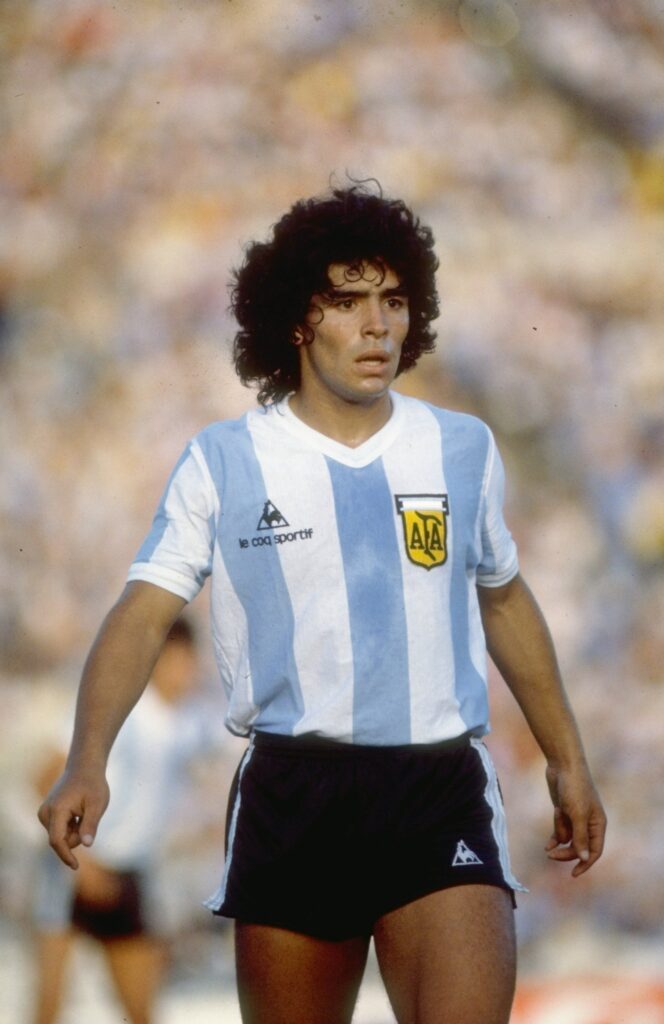

It might be easy to assume that shrines aren’t built for soccer gods, but anyone who has been to a crowded corner at the top of the narrow Via Emanuele de Deo in Naples, Italy, will know that can’t possibly be true. Because it’s here that the Largo Maradona, a two-story mural of iconic soccer player Diego Maradona wearing his blue jersey, white shorts and flowing hair, has become a destination for many a global pilgrim since it was first painted in 1990.
The legendary Maradona is the unofficial patron saint of Naples. It’s no coincidence that the latter half of the name of the street — “de Deo” — translates to “of god.” The mural became the anchor for an explosion of tributes to Maradona throughout the Spanish quarter of the city. Not only is there a constant stream of locals, tourists and soccer fans packing the area to pay tribute, the surrounding streets overflow with art, posters, T-shirts and kits honoring the city’s favorite son.
The thing is, Maradona isn’t from Naples. Italy’s third-largest city, with a population just under a million, was home to Caravaggio, Sophia Loren and even all-time defender Fabio Cannavaro, yet the city embraced Maradona as its chosen progeny. So, what was it about this Argentine playmaker that made him so beloved in Italy?
Well, there was his goal against England, in the 1986 World Cup. An incredible end-to-end masterpiece that saw him dribble through nearly the entire English team, with 11 touches in 11 seconds, before calmly tapping the ball into the net –– a goal rightfully named the Goal of the Century by FIFA. There were countless impossible passes that left defenders shaken and goalkeepers looking like fools. And of course there were more than 300 goals for club and country in the course of his career. Maradona’s level of play was so good that he was the first ever Barça player to receive an ovation from the fans of archrivals Real Madrid, after scoring a goal so incredible they had no choice but to stand up and cheer. Along with Pelé, Maradona was named Co-Player of the Century by FIFA, cementing his status as an all-time great. To state the obvious, Maradona is one of the most creative and inventive people to have ever played the game.
However, it wasn’t just skill that made Maradona beloved. It was the love, flair and style with which he played the game. Fans used to flock to the pitch hours before a match just to watch Maradona’s warm-up routine, the way NBA fans today rush to watch Stephen Curry do the same. Maradona’s wizardry with the ball was pure magic. He juggled with a fluidity and touch rarely seen before or since. And he did it while smiling. These were the moves every kid in Italy was emulating at their local pitch, one day dreaming of being the next Maradona.
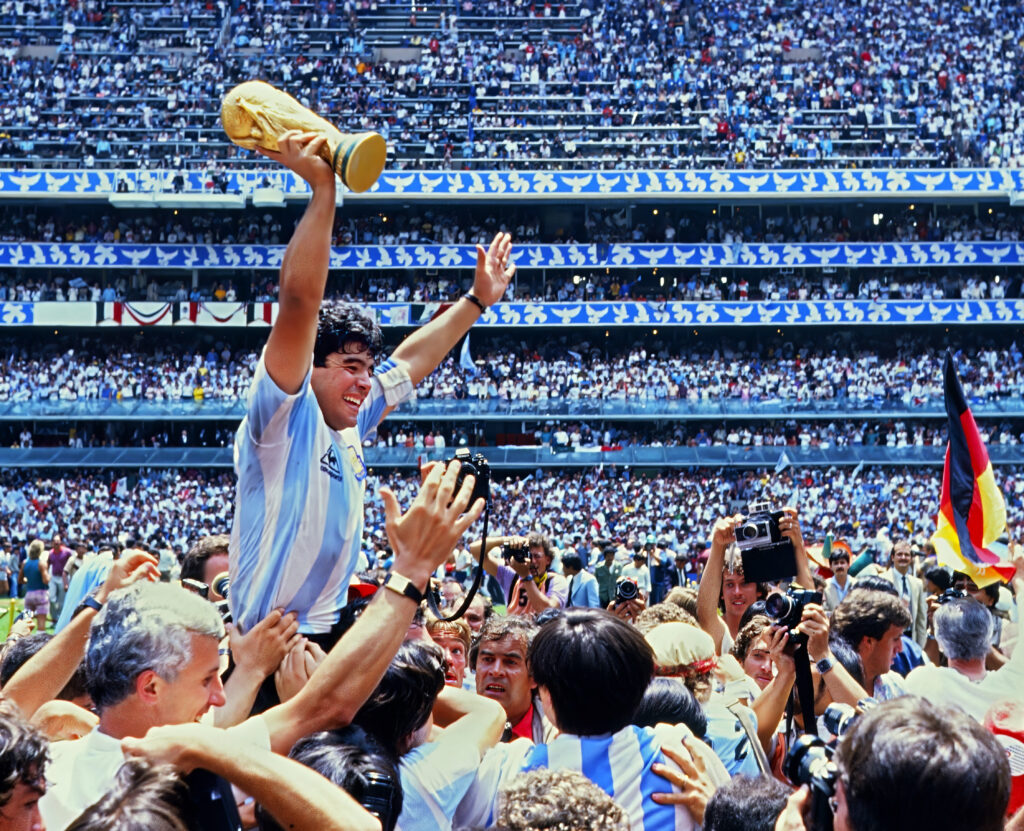
When he played, it made you feel like you were witnessing magic. Many of the game’s greats are called “clinical” as a compliment, and while no one can take away their goals or their place in the record books, respectfully, clinical can’t make you feel the way Maradona’s play did. There was nothing clinical about his game. As he sped down the field, as if on the brink of losing control, what you saw was unbridled power. A kind of freedom of movement. It was as if anything could happen when the ball was at his feet. Watch clips of Maradona today and you’ll be reminded of why it’s called the beautiful game.
Maradona’s ascension to the spotlight was far from assured. He was born in Lanùs, Argentina, and raised in a literal shantytown on the outskirts of Buenos Aires. His family struggled to survive. Yet, at a very young age, his soccer prowess was obvious. He was quickly scooped up by the local soccer power brokers and made his professional debut when he was only 15 years old, playing for the Argentino Juniors. Just five years later, he was snatched up by Argentine powerhouse Boca Juniors, with whom he won his only domestic title.
Fast-forward to 1982: Barcelona, paying what at the time was a world-record transfer fee, acquired the 21-year-old Maradona from the Boca Juniors. Barcelona, whose motto is més que un club (more than a club), is one of the most prestigious clubs in the world. It is a dream destination for nearly every soccer player. Yet for Maradona, it didn’t quite fit. Despite scoring 38 goals and delivering 23 assists in 58 matches and winning three trophies in his time with the club, he never seemed at home in the glitzy European city. Just two years after joining Barça, in one of the most shocking moves in soccer history, Maradona signed with Napoli.
No one could believe that one of the world’s greatest players was going to a team that hadn’t won many trophies, battled relegation and had even spent time wallowing in the second division. The story told time and time again is that Maradona had walked the city streets alone at night before signing and felt a connection and communion with the city. It reminded him of home.
At the time, the Northern Italian teams had all the money. That’s where the star players wanted to go. Bringing Maradona to the south was quite the coup, representing a huge victory not just for the team and the city, but for the region. In Italy, southern soccer fans were used to being taunted by northern team’s fans, known for yelling things like “You are the sewer of Italy.”
Maradona felt a connection with the city, and the city felt it too. Together, they rose to global prominence. Not only did the team win Serie A, the UEFA Cup and Italian Supercup during Maradona’s tenure, Napoli catapulted into the upper echelon of European soccer. It was in Naples that Maradona turned from a man into a god.
But he was an imperfect god. Like many before him, the power that came with success proved to be too much. Soon, the spotlight had shifted from the pitch to his personal life. Maradona once confessed that he played on Sundays, went out after the games, and stayed out until Wednesdays. Then, he started training again on Thursday. The women, the wild nights and the drugs seemed to take over. Rumors of cocaine use and addiction moved beyond locker-room gossip and into the tabloids. Maradona’s stratospheric rise came with an equally precipitous fall: Seven years after he arrived in Naples and ascended to the clouds, Maradona found himself back on earth, among mere mortals. In 1991, he was suspended for 15 months after testing positive for cocaine, effectively ending his career at Napoli. He would bounce around between a few lesser clubs before eventually retiring, but for many, his departure from Naples felt like the true end of his career.
It was a shameful exit for one of the world’s greats. One can’t help but wonder what brilliant feats of soccer fans were robbed of thanks to Maradona’s off-the-field antics. Of course, it’s not that simple –– because it was his imperfections that made him what he was. His flaws reflected the human flaws of his fans, and because of this, they were more than happy to say, “He’s one of us.” Besides, angels don’t win titles.
There are a handful of soccer players across the ages who can rightfully be called the best. There are fewer who can say they transcended the sport to become pop-culture icons. Maradona is one of them. For “El Pibe de Oro” or the Golden Boy, as he was called –– though he wasn’t golden, as in perfect, nor a boy, as in innocent –– it’s fitting that his most enduring monument is a mural in an alley that is always packed. For the player whose imperfections met with immortal grace to create once-in-a-lifetime moments on the pitch, massive statues and shiny medals couldn’t begin to capture the spirit of Maradona. For that, you need a tribute painted on an apartment building wall on the Via Emanuele de Deo: alive, at street level, and of the people. Also somewhat imperfect. Just like Maradona. And just the way he would have wanted it.