

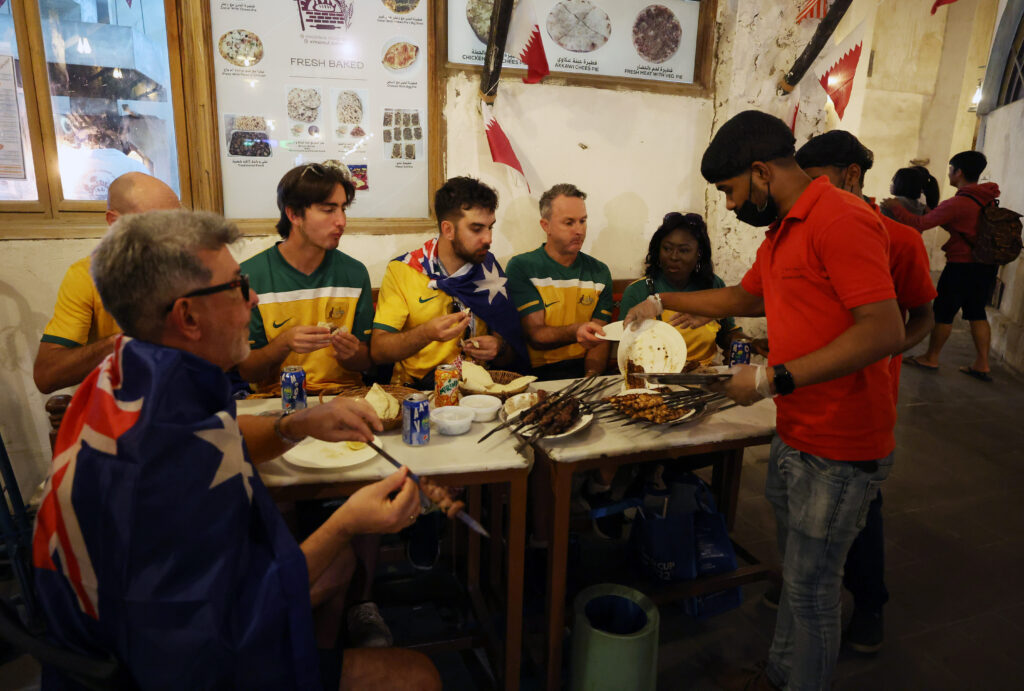
You can’t talk about sports fandom without talking about food. To be a sports fan is to be part of a culture, and every culture has its traditional foods. But because they’re regionally defined, the foods associated with soccer are about as varied as the countries that love the sport. It’s impossible to generalize –– or even quickly sum up –– what a match-day meal (or “scran”) is going to look like during this year’s World Cup, but where there are soccer fans watching a match, there will be good food made to reflect local custom, team affiliation, or both –– and lots of it, too. “Soccer, just like food, is about identity,” writes José Andrés for National Geographic. “It makes you ask yourself who you are.”
Spanning North America, with 48 teams representing a global cohort of fans, those watching will consume everything from Eccles cakes to tacos, ramen to Milanesa Napolitana, fish ’n’ chips to croquettes and every possible combination of pretzel, peanut, chip and beer. Though McDonald’s usually vends FIFA events, it won’t be serving 2026 World Cup goers. Burgers and fries, a staple of US stadium fare, however, will no doubt make an appearance. Based on other recent events, like Club World Cup, and online simulators, they’ll cost around $20 for the former and $8 for the latter. If you want a soda, anticipate another $16. Tourists traveling to Los Angeles for the World Cup are expected to pay just over $2,000 per person for food, lodging, transportation and other goodies (presumably souvenirs), based on a 2024 study by Microeconomics (now owned by Economics Research Services). Technomic estimates a $1.9 billion gain in the US food-service industry during the World Cup, as tourists flock to host cities and Americans head to local restaurants hungry for game-day foods and widescreen TVs.
In short, food and sports equals really big business. Even when people stay in. A retail and shopper marketing agency in the UK called Savy conducted its own study and found that close to 60% of those polled said they were going to “get involved” in the 2026 World Cup –– even those who weren’t actually soccer fans (47%). And of those, just over half will watch the matches from home. Their “expected behavior” includes, yes, eating and drinking. Likewise, in the US, projected numbers are similar: at least 50% plan to watch, and 70% assume they’ll spend at least $100 extra on related activities.
A few sports-related cookbooks give us a glimpse of typical game-day favorites in the US. In The Hungry Fan’s Game Day Cookbook: 165 Recipes for Eating, Drinking & Watching Sports, by Diana Falk, we see buffalo wings, of course, and sliders, but also honey-lime sriracha salmon. The latter is a favorite of LeBron James, who is one of several athlete contributors to Falk’s book. In The Ultimate Sports Fans’ Cookbook: Festive Recipes for Inside the Home and Outside the Stadium, David Bowers collected 50 recipes (organized by sport) that include ranch pretzel party mix, baked chiles rellenos, pizza and cookies.
While generalizations about specific food-related soccer traditions are impossible to make, what is possible to make is this statement: During the World Cup, people are going to shop, cook and eat –– a lot. And what they eat will subtly describe where they are, who they’re rooting for, and something of their relationship to their identity as a soccer fan. Because foods tied to local fan tradition are inherently linked to fandom itself. “When you eat a tasty dish at a stadium, that day becomes more than just the scoreline. It is an invitation into a culture, a neighborhood, a lifestyle,” writes Luis Miguel Echegaray for ESPN.
There’s research behind identifying with a team through eating habits, too. “Fandom is social identity — it’s belonging to a group. This identification, which academics call ‘team identification,’ includes many unwritten rules, including those related to eating and drinking,” Aaron Mansfield told us. An assistant professor of sport management with a PhD at Merrimack College, Mansfield is watching the build toward the World Cup with particular interest. “The scope of this event is just incredible,” he says. “The World Cup exemplifies exactly what I research — some people see fandom merely as entertainment, but for others it comes down to identity. That’ll be clear when we see the passion in the stadiums.”
And no, you don’t have to eat to be a fan, but eating is undeniably a big part of fandom for many, many sports lovers. And not just because watching a game means hanging around long enough to need a meal. Eating for many fans is a pathway to belonging; “a way to signal their allegiance to the team, improve their standing among fellow fans and contribute to what makes the fan base distinct in the eyes of its members,” Mansfield writes in a piece called “Wings, Booze and Heartbreak — What My Research Says About the Hidden Costs of Sports Fandom.”
And there in that title is the pivot to the flip side of food and fandom: While it’s well and good to enjoy the fun and festivities associated with game day, it comes at a cost, and that cost is our health. In North America, as in Europe, game day foods tend to skew rich, salty and fatty. Binge drinking is common. Not unlike a holiday, game day suggests –– almost demands –– overindulgence. “There is a Pavlovian relationship there,” said Mansfield. “Like eating popcorn when you watch a movie.”
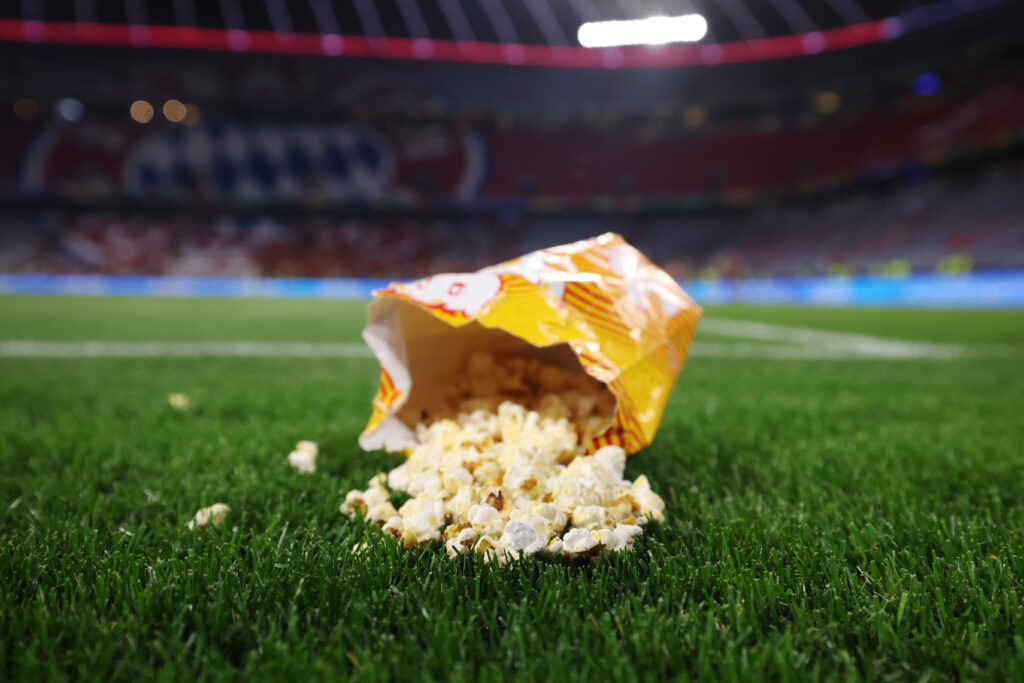
The foods we’ve been trained to reach for (by sports cultures as well as the industries built around them) while we’re watching tend to be high in calories and low in nutritive value. Even movie-theater popcorn, which might not register as “bad,” packs a caloric punch. “One of those large tubs is three-fourths of a day’s calories,” Marion Nestle, renowned professor of nutrition at New York University, told The New York Times in 2009. “You could share a tub of popcorn with 10 friends. Or, what a concept, watch the movie without eating anything.”
That’s not likely for either moviegoers or sports fans, but what is likely is a change in what we eat, and what we’re sold, when we watch. The 2020 launch of FootyScran, social media accounts dedicated to photos of the bleak concessions available at stadiums across the UK, had a surprisingly outsize impact. A few years later, headlines like “How the Footy Scran X Account Changed Match-Day Meals” cropped up to describe how FootyScran’s simple, inadvertent muckraking gave stadiums the kick they needed to put better food in front of fans. “This food revolution is a world away from the burnt sausage rolls, cremated pies, soggy chips, and questionable hot dogs that most football fans will remember from years gone by,” writes a reviewer for CityAM in 2024.
“I think FootyScran has done so well because the correlation between food and football is so massive,” founder Tom Sibley told ESPN in 2024. “For a great amount of people, it’s part of the match-day ritual.”
Though shaming the industry into rebooting stadium snacks may move the industry needle, it doesn’t change what most of us still probably think of as game-day eats: fried food, loads of sugar, and alcohol. But that too could be changing. Gen Z, a more health-conscious generation than previous ones, isn’t invested in sports the way older adults are. Though their study is now almost six years old, in 2020 the Morning Consult saw that “Gen Zers currently between ages 13 and 23 are less likely than the general population to identify as sports fans.” And in a second study, the same outlet found that “Fifty-three percent of the 1,000 Gen Zers surveyed considered themselves sports fans, compared with 63 percent of U.S. adults and 69 percent of millennials.” More health conscious, and not nearly as invested in sports, this new generation just might relate to the athletes on the field –– whose fitness regimens and diets are well-documented, thanks to social media –– more than to the fans bonding over long, boozy afternoons in the sun.